
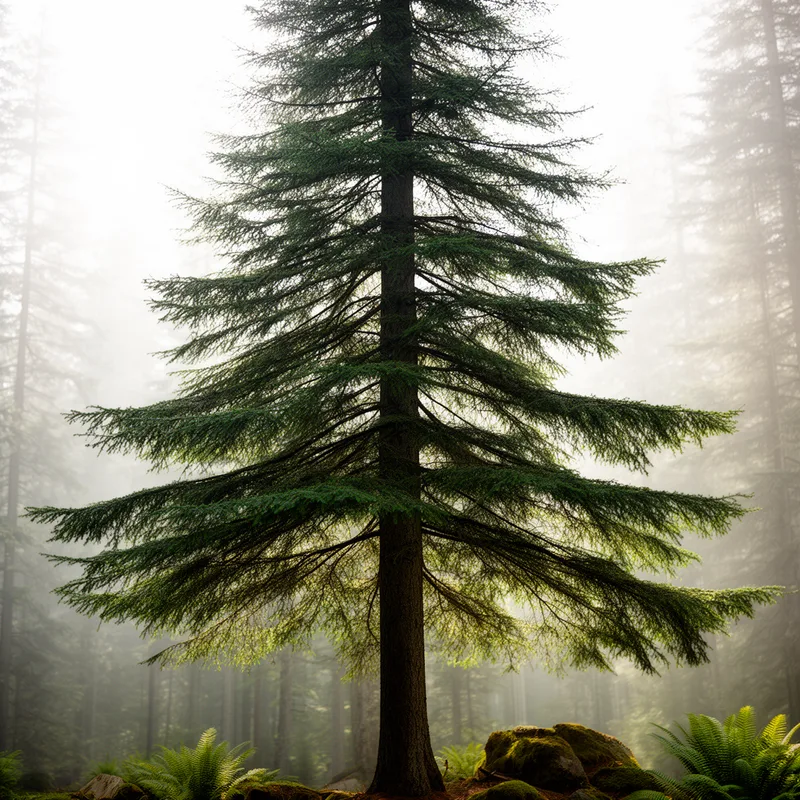
Abies grandis
- noun
- /ˈeɪbiːz ˈɡrændɪs/
- Specialized
- The towering Abies grandis trees dominate many forests in the Pacific Northwest.
Examples
-
The long, curved branches of Abies grandis make it easily recognizable among other fir trees.
-
The fragrant boughs of Abies grandis are often used in holiday decorations.
-
Botanists studied the needle pattern of Abies grandis to distinguish it from other firs.
-
The Abies grandis is known for its impressive height.
-
In the Pacific Northwest, the Abies grandis thrives in moist conditions.
-
In the Pacific Northwest, the towering Abies grandis trees provide habitat for various wildlife.
-
During the winter holidays, many families decorate with boughs of fragrant Abies grandis.
Synonyms
A tall fir tree that grows on the Pacific coast with long curved branches and dark green needles

A very tall evergreen tree from northwest America with long curved branches

A tall tree with long curved branches and dark green leaves that grows by the Pacific coast

A tall tree with long curved branches and dark green needles that grows on the Pacific coast
Surface Forms
Morphology
Abies + grandis
This is a Latin binomial: 'Abies' denotes the fir genus while 'grandis' is a Latin specific epithet rather than a common English word. Because taxonomic names follow Latin conventions and the second element is not a familiar English morpheme, a B1 learner would not reliably derive the common-meaning 'grand fir' from the parts, so the expression is opaque.
Etymology
Abies grandis gets its name from Latin: Abies means 'fir' and grandis means 'large' or 'grand', so people called this tall, impressive tree the 'grand fir' to show it is a big fir tree.

