

lowland fir
- noun
- /ˈloʊˌlænd fɪr/
- Specialized
- We identified a lowland fir by its deep green needles and gracefully curving branches.
Examples
-
The lowland fir can grow up to 200 feet tall.
-
The lowland fir thrives in the moist forests along the Pacific coastline.
-
Foresters are studying how climate change affects the growth of lowland firs.
-
Many lowland firs thrive in the moist climate of the Pacific Northwest.
-
The lowland fir thrives in the moist forests along the Pacific coastline.
-
Foresters are studying how climate change affects the growth of lowland firs.
-
We identified a lowland fir by its deep green needles and gracefully curving branches.
Synonyms
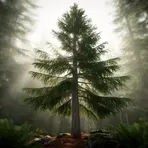
A tall fir tree that grows on the Pacific coast with long curved branches and dark green needles

A tall tree with long curved branches and dark green leaves that grows by the Pacific coast

A very tall evergreen tree from northwest America with long curved branches
Surface Forms
Morphology
The meaning 'a fir that grows in low-lying land' is directly and transparently derived from combining 'lowland' (low-lying land) with 'fir' (a conifer tree). This descriptive noun–noun compound follows a common and cross-linguistic pattern of habitat-based naming, so a B1 learner who knows both constituents would readily infer the MWE meaning.
Etymology
Lowland fir comes from a simple picture: lowland means low, wet land near the coast and fir is a type of evergreen tree, so it names a fir that grows in low coastal ground. That's why the phrase means 'a tall fir tree' that lives in moist coastal lowlands.

