
balsam fir


 1
4.9
1
4.9
- noun
- /ˈbɔːlsəm fɜr/
- US
- In the dense forests of Canada, the balsam fir thrives alongside other evergreen trees.
- balsam fir and spruce
- red balsam fir
Examples
-
Near Ellen Lake, Buchert spots a moose cow and calf lying together under a balsam fir.
Academic text (2009) -
In addition to balsam fir, they often host red spruce, white spruce, mountain ash, and heart-leaved paper birch.
Academic text (1998) -
Red spruce and balsam fir are the major species here.
Academic text (1998) -
It is a sprig of balsam fir all the way from New Hampshire.
-
A trail along the lower reaches of the brook passes through a forest of red spruce, balsam fir, and paper birch.
Academic text (1998) -
The Rail 'n' River Trail is an easy half-mile loop through a forest of red spruce, balsam fir, and northern hardwoods.
Academic text (1998) -
Common trees are red spruce and balsam fir, interspersed with such broad-leaved species as American beech and sugar maple.
Academic text (1998) -
The Kancamagus Highway reaches its high point at a mountain pass, where most of the forest consists of red spruce and balsam fir, with scattered heart-leaved paper birches.
Academic text (1998) -
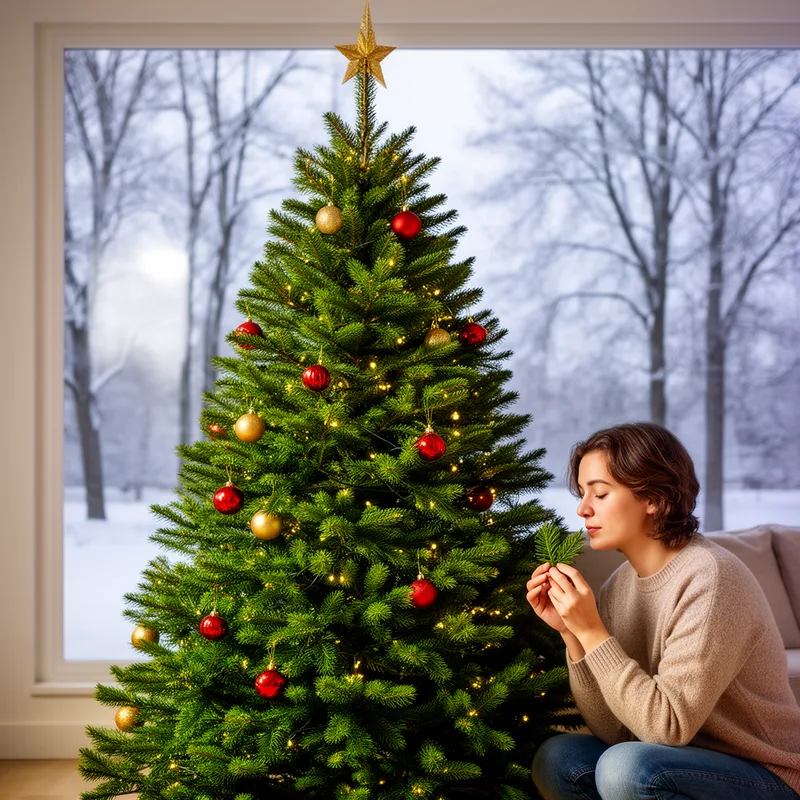
During the holiday season, many families like to choose a balsam fir as their Christmas tree.
-
The balsam fir is known for its pleasant aroma and is commonly found in northeastern North America.
Synonyms
 22
1.6
22
1.6
A tall evergreen tree with needle leaves and upright cones often used as a Christmas tree
 5
2.0
5
2.0
A tall evergreen tree with soft needles often used for holiday decoration

A medium-sized fir tree from northeastern North America with fragrant needles often used as a Christmas tree

A medium fir tree from northeastern North America used for Christmas trees and paper

A medium-sized evergreen tree with needles that smell of pine

A tall evergreen tree with needle leaves and upright cones often used as a Christmas tree
Surface Forms
Morphology
The compound is directly compositional: 'balsam' denotes an aromatic/resinous quality and 'fir' names the tree, so together they denote a fir tree with balsam-like aroma. This follows a standard noun+noun naming pattern (a type of fir), so a B1 learner who knows both constituents can infer it denotes a specific kind of fir (commonly used as a Christmas tree).
Etymology
Balsam fir is named because the tree makes a sticky, nice-smelling balsam or sap that you notice when you crush its needles. That's why the name means a fir tree known for its fresh scent and why people often use it as a 'Christmas tree'.