
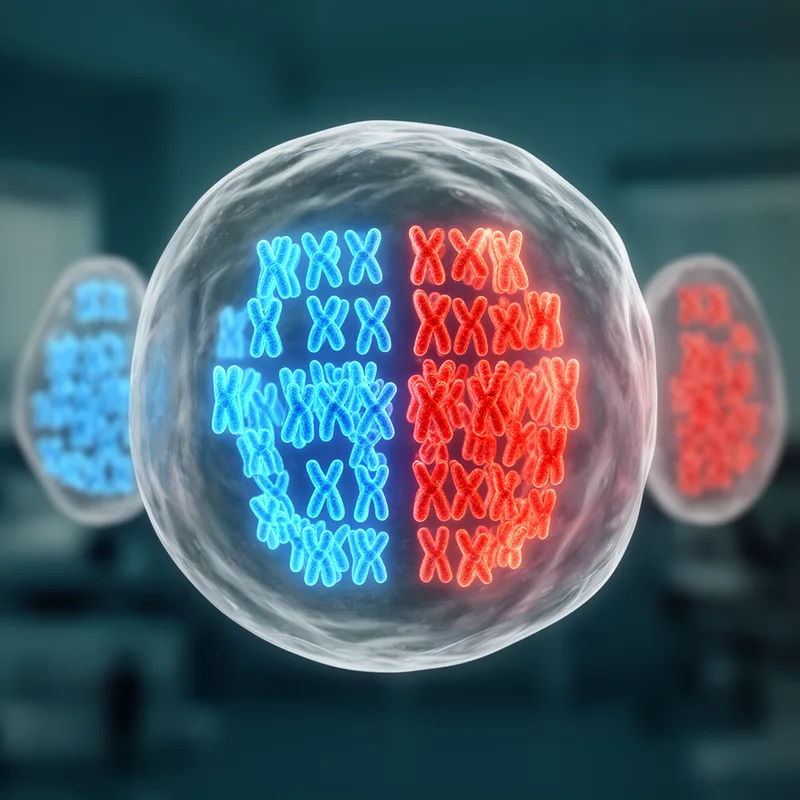
diploid
- adjective
- /ˈdɪp.lɔɪd/
- Specialized
- That's the ants, the bees and the Wasps, where the females are diploid, they have two chromosomes.
Loading YouTube…
Watch on YouTubeThat's the ants, the bees and the Wasps, where the females are diploid, they have two chromosomes.
- That's the ants, the bees and the Wasps, where the females are diploid, they have two chromosomes.
Examples
-
So you go from a haploid stage to a diploid stage.
-
In sexual reproduction, the fertilized egg is a diploid cell containing one set of chromosomes from each parent.
-
And again, the daughter cells are both diploid, OK?
-
So for that one gene, this cell could be thought of kind of maybe a little bit like a diploid, just that that one gene.
-
Excuse me, the sexual diploid part doesn't fit for malaria and sleeping sickness.
-
How much time you spend in the diploid or in the apploid phase, That's all it does.
-
Table 1. Kin structure (i.e., degree of relatedness) in male = haploid, female = diploid species.
Academic text (1999) -
So we are fortunate that we are deployed with primordial germ cells that are self renewing and we start off with a diploid primordial germ cell.
-
In male = haploid, female = diploid species, workers in colonies headed by one singly mated queen are related by 0.75 to their full sisters, but only by 0.25 to their brothers (Table 1).
Academic text (1999) -
Females of many species are diploid, having two complete sets of chromosomes, while males can be haploid.
Antonyms
How Many
- Specialized

- Specialized
- Specialized
- Specialized
- Specialized
- Specialized
Surface Forms
Morphology
diploid = di + ploid
Formally analyzable as the combining prefix 'di-' (two) + the combining form 'ploid' (relating to fold/set), but these are technical combining forms rather than common standalone English words, so the relation is clear to learners with scientific vocabulary but not to average learners.
Etymology
Diploid comes from Greek parts di- meaning 'two' and -ploid meaning 'fold' or 'layer', so it literally means 'double' or 'twofold'. That's why we use diploid to describe a cell that has two complete sets of chromosomes, one set from each parent.

