

congress
 5
3.7
5
3.7

- noun
- /ˈkɒŋɡrɛs/
- Formal
- The new policy proposed by the president must be approved by Congress before it can take effect.
Loading YouTube…
Watch on YouTubeAnd finally the American people and Congress are out talking about it.
- And finally the American people and Congress are out talking about it.
- They're getting destroyed by Congress about privacy concerns.
- If the law is worth keeping, Congress can pass it again.
- And second of all, most people in Congress don't think of themselves as crooks.
- And also the Republican Congress withdrew a lot of the funding for them.
- The worry is that the US might have a Congress that's unable to agree on anything.
- Anyway, I I agree with you Heather, it's a problem and Congress needs to act.
- No, we, we go to DC and, and talk to members of Congress, talk to their staff, talk to.
- These are all kind of the sort of stuff that we expect Congress and the executive to do.
- Trump, you pay attention as you know that Donald Trump and Congress are fighting.
- But it was really Congress that site anyway.
Examples
-
And also the Republican Congress withdrew a lot of the funding for them.
-
And I hope that, I hope I'm wrong and I hope that Congress acts on this quickly.
-
If the law is worth keeping, Congress can pass it again.
-
And finally the American people and Congress are out talking about it.
-
So if you want Environmental Protection, go to Congress and get them to want it.
-
Now that you are in Congress, what do you think can be done?
-
It's the moment every member of Congress fears having to work longer hours.
-
The worry is that the US might have a Congress that's unable to agree on anything.
-
The bills that he's trying to push through Congress are not popular.
-
Right now, he faces a divided congress during a hotly-contested re-election year.
Synonyms
 449
3.5
449
3.5
The group of people who make and pass a country's laws
 356
5.3
356
5.3
A group of people who make and change the laws of a country or region
 28
2.5
28
2.5
The part of the United States government that makes laws, made of the Senate and the House of Representatives
 24
2.5
24
2.5
A national group of elected people who make United States laws and includes the Senate and House of Representatives
 10
3.0
10
3.0
A national body that makes laws, including the Senate and the House of Representatives
 8
4.5
8
4.5
An official group of people who make and change laws for a country or state
 1
6.8
1
6.8
A group of people who make laws for a state or country


 1
5.4
1
5.4
A group of elected people who make and change laws for a country or region
Compounds
28
2.5
The part of the United States government that makes laws, made of the Senate and the House of Representatives
- Formal
24
2.5
A national group of elected people who make United States laws and includes the Senate and House of Representatives
- Formal
10
3.0
A national body that makes laws, including the Senate and the House of Representatives

 5
6.4
5
6.4
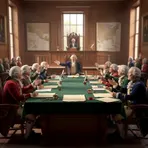
An assembly of colonial representatives who met during the American Revolution to govern and form a national government

 1
6.9
1
6.9
A group of Iraqi opposition leaders and parties formed in 1992 to oppose Saddam Hussein



- Archaic
An ankle-high shoe with elastic sides, worn in the 1800s and early 1900s

A group of trade unions in North America formed in 1935 that joined the American Federation of Labor in 1955


- NSFW
Sexual activity the law makes illegal, for example sex with a close family member or with a child
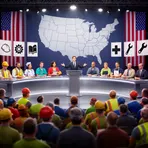
A large group of trade unions in the United States that represents workers
How Powerful

Surface Forms
Morphology
congress = con + gress
The institutional sense ('the national legislative body') is an extended, specialized meaning of the same Latin-derived formation; learners cannot infer this specific institutional sense from the morphemes alone.
Etymology
The word congress comes from the Latin parts con- 'together' and -gress 'step', the same root as progress. That's why Congress is the national group of people who 'come together' to make laws.