

parliament
 449
3.5
449
3.5

- noun
- /ˈpɑːrləmənt/
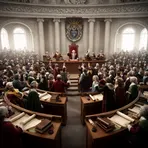
- In the UK, the parliament is responsible for creating and passing new laws.
- member of Parliament
- a party in Parliament
- Speaker of Parliament
Loading YouTube…
Watch on YouTubeHow does the UK Parliament carry out these duties?
- How does the UK Parliament carry out these duties?
- That's similar to ruling without parliament for an English king.
- But it's great to to come to Parliament to speak about Alice's life.
- A government taking us out, but Parliament's got to have the final say on this.
- So that is another act of parliament that I think we need to reverse.
- Europe, I think the European Parliament is, is starting to crack down on that.
- And yet Ukraine had an open public sphere and it had a parliament that functioned.
- And galvanized by this, reformers in parliament are now investigating dubious contracts.
- And we arranged it through one of the Lords of Parliament.
- And a lot of a lot of countries will apportion seats in the parliament to ethno religious groups.
- He encouraged the lower nobility to create local parliaments.
- They didn't have a parliament that has a LGBTQ party.
- It means that you are a member of Parliament, a club, right?
Examples
-
Amendments to the law were under consideration by Parliament in the summer of 1999.
Academic text (1999) -
Both houses of Parliament reassembled in New Delhi this morning... after an interval of six weeks.
-
When the King said Parliament, he meant both Houses of Parliament.
-
But if we're discovered, parliament will remove you from office.
-
Then he said, "Parliament had not the power to do it."
-
How does the UK Parliament carry out these duties?
-
So, against all initial expectations, Parliament had won an outright victory.
-
In Canada, we do have legislation before our Parliament to provide some privacy protections.
Academic text (1999) -
But a month later, after a fierce debate in Parliament, her citizenship was reinstated.
Academic text (2008) -
After the election, many citizens hoped the parliament would address their concerns promptly.
Synonyms
 356
5.3
356
5.3
A group of people who make and change the laws of a country or region
 14
3.6
14
3.6
The part of government that makes laws
 8
4.5
8
4.5
An official group of people who make and change laws for a country or state
 5
3.7
5
3.7
The national group of elected people who make and change laws
 4
4.9
4
4.9
A group of representatives who make and change laws for a state or organization
 1
9.8
1
9.8
A national assembly that meets to make laws for a country


 1
5.4
1
5.4
A group of elected people who make and change laws for a country or region
An old spelling for a national group that makes laws and decisions
Compounds
 8
3.5
8
3.5
A group that makes laws for the United Kingdom with two parts, Commons and Lords
 3
3.7
3
3.7
A person elected to represent an area in the UK Parliament, especially in the House of Commons


The group in Poland that makes laws and has two houses, the Sejm and the Senate
How Broad
802
3.2

- Formal
14
3.6
449
3.5
356
5.3
88
2.4
Surface Forms
Morphology
parliament = parley (opaque) = parl + ment
Although historically formed from a verb meaning 'to speak' plus '-ment', the modern sense 'legislative assembly' is not directly derivable for an average learner from the base form.
Etymology
Parliament comes from the old French verb parler, which means 'to speak'. It was first the name for a meeting where people came together to talk and decide, so a parliament today is the place where representatives speak and make laws.