

to break with
 440
4.1

- phrasal verb
- /breɪk wɪð/
- She has broken with me.
- broke with tradition
- break with convention
- break with the past
Loading YouTube…
Watch on YouTubeHe ends up breaking with FDR during the New Deal.
- He ends up breaking with FDR during the New Deal.
- And pretty soon they, you know, they break with him as well over the Algerian war.
- Yeah, that's how they broke with tradition.
Examples
-
We know that society evolves, we progress, we break with these archaic notions of who's fit to serve as our leaders.
-
I want you to tell her that I cannot explain... why I broke with her as I did.
-
You broke with me first, remember?
-
I just broke with my boyfriend.
-
I broke with my friend Tom Wilson this afternoon.
-
To this end, shortly after taking office, Bush broke with tradition by choosing Mexico for his first foreign visit.
Academic text (2001) -
Earlier in my political career, I was a member of the NRA, and as it became more and more radicalized, I broke with the NRA.
-
The political climate demands female candidates break with gender stereotypes to run successful campaigns and be effective legislators in office.
Academic text (2013) -
I just broke with my boyfriend after our long disagreement.
-
She decided to break with her old friends to focus on her career.
Synonyms
 968
2.6
End a relationship with someone, for example a romantic or business partner
 580
2.3
End a relationship or go separate ways
 432
5.1
To end a romantic relationship suddenly and without care
 321
2.9
To move apart or stop being together
 165
2.7
To end a close relationship and go separate ways
 128
3.2
To stop something suddenly before it is finished, for example a talk or relationship
 69
4.1
To officially end an organization, agreement, or relationship
 55
5.8
To end a relationship or connection completely by stopping all contact
 28
3.9
To stop being together or working with someone and go in different directions
 27
4.1
To leave an organization and form a separate group
 16
6.6
To stop depending on someone or something and become independent
 15
7.0
To end a connection with a person, group, or idea
 5
6.7
To stop being involved with a person, group, or idea
 3
4.6
To end a relationship or connection with someone
 1
7.4
To suddenly end someone's job or a relationship, often without warning


 1
7.5
To stop being a member of a group or organization
 1
9.9
To end a relationship or job suddenly and harshly

End someone's job or relationship suddenly and without warning
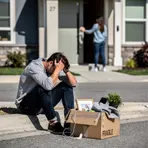
Suddenly stop seeing or talking to someone
Antonyms

How Decisive
55
5.8
 440
4.1
- Informal
16
6.6
28
3.9
18
3.7
Surface Forms
Morphology
The sense 'to end a relationship or association' is directly derivable from combining 'break' (to stop or end) with 'with' (marking the party or thing associated), so together they plainly mean 'end association with X'. This compositional pattern (break + preposition indicating what is being broken from) is common in English and across languages, so a B1 learner who knows both constituents would likely infer the MWE meaning.
Etymology
Break with comes from the simple image of break and with: imagine snapping a rope or chain that tied a person to a group or idea. So, to break with someone or something means to 'end' that connection or relationship.