

australopithecine
 1
9.9
1
9.9

- noun
- /ˌɔːstrəloʊˈpɪθiˌsiːn/
- Specialized
- All our ancestral species going back to the australopithecines seem to have been polygamous.
- Australopithecine child
Loading YouTube…
Watch on YouTubeAll our ancestral species going back to the australopithecines seem to have been polygamous.
- All our ancestral species going back to the australopithecines seem to have been polygamous.
- And it was a, an evolution from a, a line of australopithecines.
Examples
-
Zeresenay found the same result when he measured the partial skulls that belonged to Australopithecine children from Laetoli and Taung.
Academic text (2007) -
Wounded Australopithecine bones thought to show war injuries actually show the tooth marks of leopards.
Academic text (2011) -
This combination is something of a mix between modern human and australopithecine anatomy.
Blog text (32) -
Selam's australopithecine shoulder blades are shown in the top two rows labeled DIK-1-1.
Blog text (15) -
Selam's remains are far more complete than those of two other Australopithecine children found in fossil beds at Laetoli in Ethiopia and Taung in South Africa.
Academic text (2007) -
The australopithecine shoulder is built like that of modern apes and presumably functioned the same, distributing the stress of the animal's weight over the entire shoulder joint capsule as it swung through the trees.
Blog text (15) -
Eventually, Vrba became head of the museum's Department of Paleoanthropology, succeeding the legendary Robert Broom, and directed excavations of robust australopithecine fossils at the Kromdraal cave site.
Academic text (1994) -
Fossils of the australopithecine were discovered in Africa, providing insight into early human evolution.
-
Researchers studied the australopithecine remains to understand how our ancestors walked on two legs.
-
The australopithecine is considered a crucial link in the evolutionary chain leading to modern humans.
Synonyms

An extinct early human ancestor from Africa that lived long ago
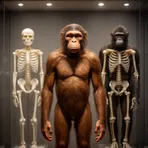
An extinct early human relative with ape features

An early human with features between apes and people today
How Human-like
- Specialized
2
4.0

- Specialized
2
8.2
- Specialized
1
9.9
118
1.0
Surface Forms
Morphology
australopithecine = Australopithecus (semi-transparent) = australopithecus + ine
Formed regularly from the genus name + the nominal/adjectival suffix '-ine', but the base is a technical scientific name unfamiliar to typical B1 learners.
Etymology
Australopithecine is named after Australopithecus, a name formed from austral- 'southern' (as in Australia) and -pithecus 'ape'. So an australopithecine is literally a 'southern ape', a way to talk about those early, ape-like ancestors found in Africa.