
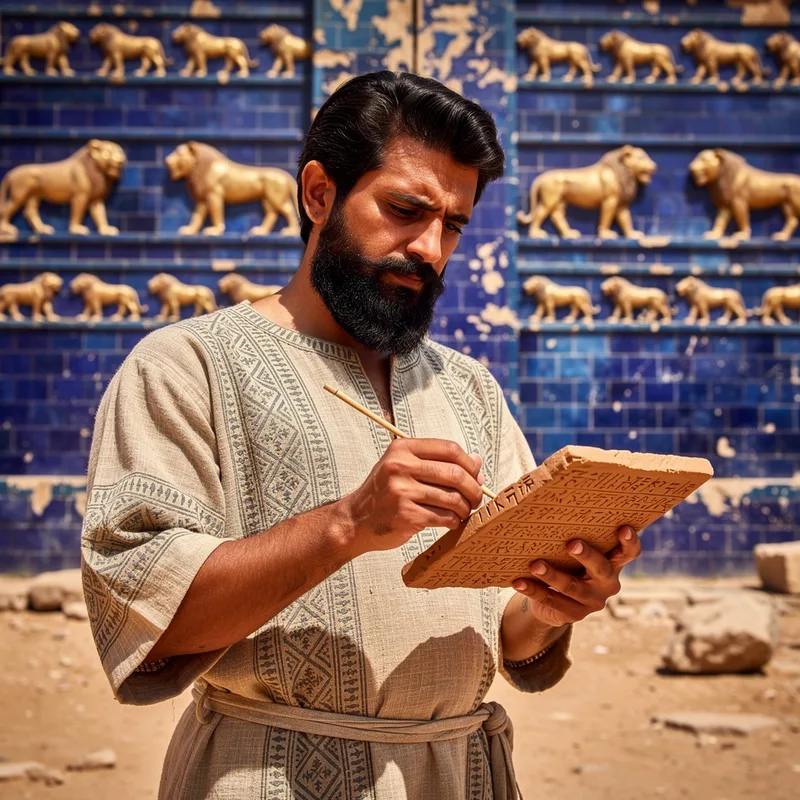
Babylonian
 8
7.3
8
7.3

- proper noun
- /ˌbæbəˈloʊniən/
- These chapters tell of Daniel's adventures under that two Babylonian kings, Numbuchadnetzer and Belshazzar.
- ancient Babylonians
- Babylonians and Assyrians
- Babylonians and Sumerians
Examples
-
More importantly, this period saw the transmission of ideas between the Indians, Babylonians, Greeks, and Persians.
Blog text (17) -
Historians often study the laws established by the Babylonian king Hammurabi to understand ancient governance.
-
The church in America is now exactly like ancient Israel before the Babylonians destroyed them.
Blog text (15) -
Before I received your "invitation", I was reading of Gilgamesh the Babylonian.
-
What's more, the Minoans were in contact with the Babylonians through Syria from an early stage.
Academic text (1990) -
Before the Greeks, the Babylonians had learned much about mathematical astronomy.
Academic text (1996) -
Naples remained the same; Jerusalem was held captive by the Babylonians.
Fiction book (1991) -
God's protection was removed, and soon the Babylonians began to overrun God's people and would then enslave them.
Blog text (16) -
Hence, two independent lines of evidence point to the Babylonians and Sumerians as the originators of our constellation system.
Academic text (1990) -
The First Temple was totally destroyed by the Babylonians in 586 BCE when they sacked the city.
Blog text (9)
Compounds


 1
9.7
1
9.7
A time when the king of Babylon took many Jewish people from Israel to Babylonia after 586 BC

An ancient flat piece of clay from Babylon with wedge-shaped writing used to record laws, trade, or stories

A tree with long drooping branches and thin leaves often planted near ponds for shade
Surface Forms
Morphology
Etymology
Babylonian as a proper name comes from Bāb-ilu 'gate of God', and that is why it refers to a person, language, or culture connected to ancient Babylon in the area of today's Iraq.