
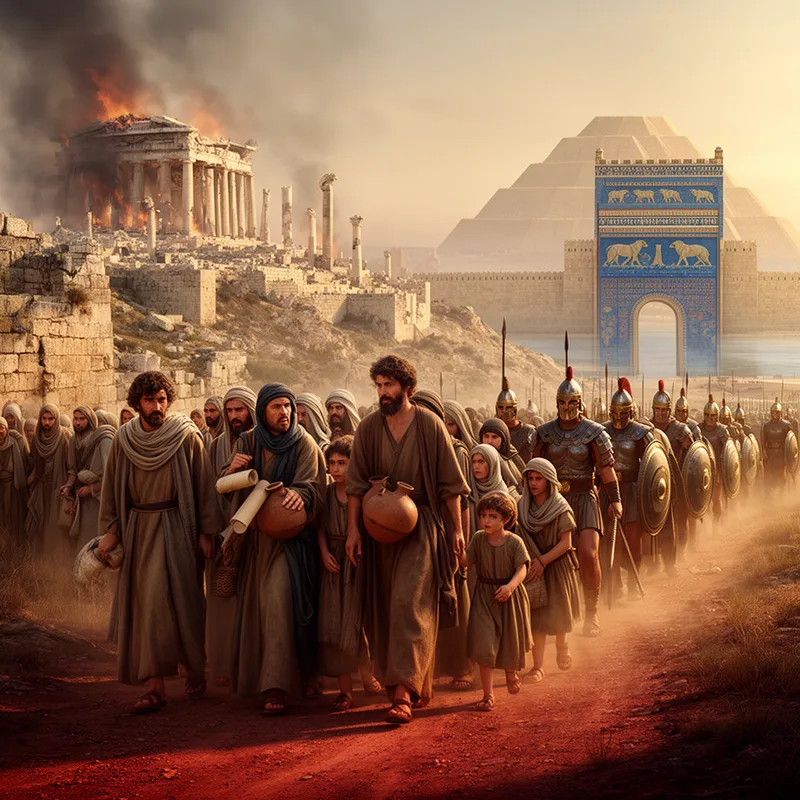
Babylonian Captivity


 1
9.7
1
9.7
- noun
- /ˌbæbəˈloʊniən kæpˈtɪvɪti/
- Many cultural practices among the Jews changed during the Babylonian Captivity, which lasted for seventy years.
Examples
-
The end of the Babylonian Captivity marked a significant moment for the Jewish people, allowing them to return to Jerusalem.
-
Just before Babylonian captivity, look how He spoke to them:
Blog text (11) -
The Babylonian Captivity.
-
Unlike the now-extinct Philistines, the Jews returned to Judea after seventy years of Babylonian captivity, only to witness successive waves of conquest.
Fiction book (2002) -
The Rasta version of verse 2 locates the Babylonian captivity in the adverbial modifier "inner" (Jamaican patois for "in a") strange land.
Academic text (2000) -
The Babylonian Captivity began in 586 BC when the Jews were forcibly taken from their homeland.
Surface Forms
Morphology
The phrase combines 'Babylonian' (relating to Babylon) and 'captivity' (being kept without freedom), so a learner who knows both words can infer it refers to being held or exiled in Babylon; the specific historical details (dates, which people) are extra information but not necessary to grasp the basic meaning. This straightforward compositional structure is cross-linguistically accessible, making the expression transparent to a B1 learner.
Etymology
The noun Babylonian Captivity comes from a real event when the king of Babylon took many people from Judah to live in Babylon and kept them away from their homeland. That's why the name now means 'a period of exile' or being 'held away from home'.