

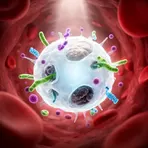
white corpuscle


 1
4.6
1
4.6
- noun
- /waɪt ˈkɔrpəsəl/
- When you get sick, your body produces more corpuscles to help fight off infections.
Examples
-
Then, white corpuscles will destroy it as they would any other invader.
-
White corpuscles, antibodies.
-
White corpuscles play a crucial role in the immune system by attacking harmful bacteria.
-
The doctor explained that corpuscles are essential for protecting the body from diseases.
Synonyms
 22
2.5
22
2.5
A cell in the blood that helps the body fight infections
 9
3.3
9
3.3
A blood cell that eats and kills germs to protect the body
 7
6.7
7
6.7
A large white blood cell that eats and removes germs and dead cells
 7
3.5
7
3.5
A blood cell that eats bacteria and fungi to help fight infection
 3
5.4
3
5.4
A white blood cell that helps the body fight infection by eating bacteria and fungi
 2
6.5
2
6.5
A large white blood cell with one nucleus that eats bacteria and other germs
 1
7.7
1
7.7
A white blood cell that eats and destroys bacteria and other germs
 1
8.6
1
8.6
A white blood cell that eats and digests small germs or particles
 1
8.9
1
8.9
A type of white blood cell with small particles inside that helps fight infection

A blood cell that helps protect the body by eating and killing bacteria and other germs
Surface Forms
Morphology
The meaning is directly and compositionally derived from combining "white" (a color) with "corpuscle" (a blood cell), so it denotes a white blood cell that defends the body. This is a literal adjective+noun construction common across languages, and even though "corpuscle" is somewhat technical, a B1 learner who knows both constituents should be able to infer the intended biomedical meaning.
Etymology
White corpuscle literally combines white and corpuscle, meaning 'small white body' in the blood, because doctors saw pale little cells moving in the blood to 'eat' germs. That's why white corpuscle now refers to the blood cell that helps 'defend' the body.