

to unloose (a) knot
- phrasal verb
- /ʌnˈluːs/
- Archaic
- It took him several minutes to unloose the knot in the shoelace.
Examples
-
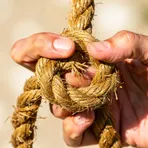
The sailor carefully unloosed the knot to free the anchor.
-
With a gentle tug, she managed to unloose the stubborn knot in her hair.
-
After the hike, she tried to unloose the knot in the rope.
-
He struggled to unloose the knot that had formed in the fishing line.
-
The firefighter worked quickly to unloose the knot that trapped the injured man.
Synonyms
 91
1.0
91
1.0

Make a knot or lace loose by undoing it
 88
1.0
88
1.0
Make something less tight so it can move or open
 38
4.3
38
4.3
To come apart into threads, like a rope or cloth
 10
3.5
10
3.5
To separate threads or cords that are twisted together
 5
3.7
5
3.7
Make a wrapped or twisted thing loose and straight
 5
3.4
5
3.4
To open something by undoing a button or zipper
 3
6.4
3
6.4
To free something by untying ropes or cords
 2
3.7
2
3.7
To make something that is twisted become straight
 1
5.3
1
5.3
To free something twisted and knotted, like a cord
 1
7.0
1
7.0
To make something less tight or set something free


 1
5.1
1
5.1
To make a tied rope or string loose so it comes apart
 1
7.6
1
7.6
To free something from a tangle, like knots in rope or wire
 1
7.4
1
7.4
To separate things that are twisted together, like cables or yarn

To make something less tight or free it from something holding it
Antonyms
How Loose
- Archaic
 88
1.0
88
1.0
Surface Forms
Morphology
The meaning 'to untie or free a knot' is directly and compositionally derived from 'unloose' (to make less tight or free) + 'knot' (a fastening). The parenthetical article '(a)' is irrelevant and the verb+noun pattern is cross-linguistically common, so a B1 learner who knows the constituent words would readily infer the MWE meaning.
Etymology
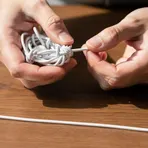
Unloose (a) knot shows a simple picture: you work your fingers to loosen the tight loops of a knot until the rope comes free. That's why it means 'to untie or free a knot'.