
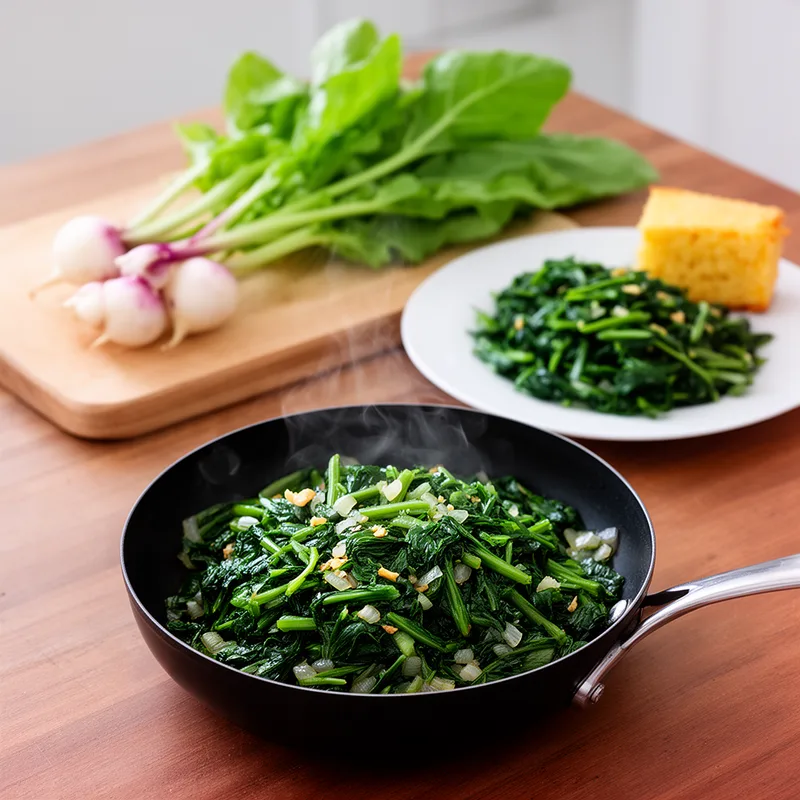
turnip greens
 1
3.7
1
3.7

- noun
- /ˈtɜrnɪp ɡriːnz/
- US
- "I had a hankering for turnip greens," Kim explains, when they are all stretching in the parking lot.
- turnip greens and mustard
- turnip greens and collard
- turnip greens and cornbread
Examples
-
If they try it again, they'll be dipping their hands into some interesting things underneath the turnip greens and rice.
Fiction book (1991) -
On Thanksgiving, everyone would play Po-Ke-No around the dining room table until Nana brought out the turkey, dressing, and the turnip greens.
Fiction book (1994) -
Even from there, the smell of boiling turnip greens hits you.
Fiction book (1991) -
The green stuff tasted a little like turnip greens.
Fiction book (2002) -
In northeast Texas in the spring, we mix turnip greens, chard, and polk salad together; very good.
Blog text (30) -
I got trout, two sides of turnip greens, some pepper sauce, a dumpling, a corn, a bean.
-
I wasn't any more than about seven or eight, and my mother, I called her Mudear too, had sent me to the store four streets over from my house to get a nickel's worth of fatback meat to go in some turnip greens.
Fiction book (1993) -
She tended a small garden in the backyard, worked it when she got home from the shoe factory: a few rows of snap beans, Irish potatoes, Big Boy tomatoes, turnip greens, and okra.
Fiction book (1996) -
There was no sign of any food that a Mississippi child might have actually been able to eat: cornbread and turnip greens, cold baked sweet potatoes, pimento-cheese sandwiches on light bread, fried chicken and slaw, and watermelon.
Fiction book (1991) -
In the kitchen of one of the Atlanta restaurants, he shows me how to make his turnip greens.
Synonyms
 95
1.0
95
1.0
Leafy vegetables like spinach or kale that you eat
 11
1.0
11
1.0
Leaves and stems of plants like spinach or kale eaten as vegetables
 2
2.5
2
2.5
A plant food with green edible leaves like spinach or lettuce
 2
1.9
2
1.9
A plant with green leaves and stems you eat
How Tender

Surface Forms
Morphology
The meaning 'the tender, edible leaves of young turnip plants' is directly and transparently derived from combining 'turnip' (a root vegetable) with 'greens' (edible leaves), following a common noun + noun compounding pattern. This compositional, literal structure is cross-linguistically regular and would be immediately understandable to a B1 learner who knows both constituents.
Etymology
Turnip greens are the tender leafy tops of the turnip plant, and people call them greens because they are eaten like other leafy vegetables. So, the name means 'the tender, edible leaves of young turnip plants'.