

terrestrial
 4
4.0
4
4.0

- noun
- /tɛˈrɛstrɪəl/
- The new World Database on Protected Areas shows that terrestrial protected-area coverage now approaches 12% worldwide.
- terrestrial ecosystems
- terrestrial area
- terrestrial and marine
Examples
-
These terrestrial plants, unlike aquatic ones, require soil to grow and obtain nutrients.
-
There are some water on mass, but very little fresh water, and the soil is tough for terrestrial plants to grow on.
-
Well, now we're going to do a analysis of a terrestrial ecosystem.
-
Species were classified as predominantly marine, terrestrial, or freshwater according to conservation advice and recovery plan documents.
Academic text (2011) -
Most pollinators of terrestrial plants visit the flowers for the collection of pollen and/or nectar.
Academic text (1996) -
Following rapid and well-documented glacial retreats, adjacent terrestrial, lake, stream, and intertidal habitats are exposed to biotic colonization and community development.
Academic text (2007) -
The rainforest is home to many terrestrial animals that thrive in the dense foliage.
-
Scientists have discovered new species of terrestrial plants that survive in extreme climates.
Compounds
- Specialized
1
4.1
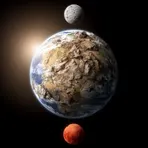
A planet with a solid, rocky surface like Earth, Mercury, or Mars

- Specialized

 1
9.0
1
9.0
A clock system that uses Earth's movement around the Sun and corrects for Earth's irregular motion

- Specialized
A time system based on Earth's orbit used to calculate planet positions

How Land-based

Surface Forms
Morphology
terrestrial = terra + ial
The formation indicates 'of the land' (land-dwelling), but because 'terra' is a combining form rather than a standalone English word, the meaning is only partly obvious to learners.
Etymology
A terrestrial (noun) comes from the Latin terra 'earth', so a terrestrial is literally an 'earth creature' that lives on land rather than in water or air.