
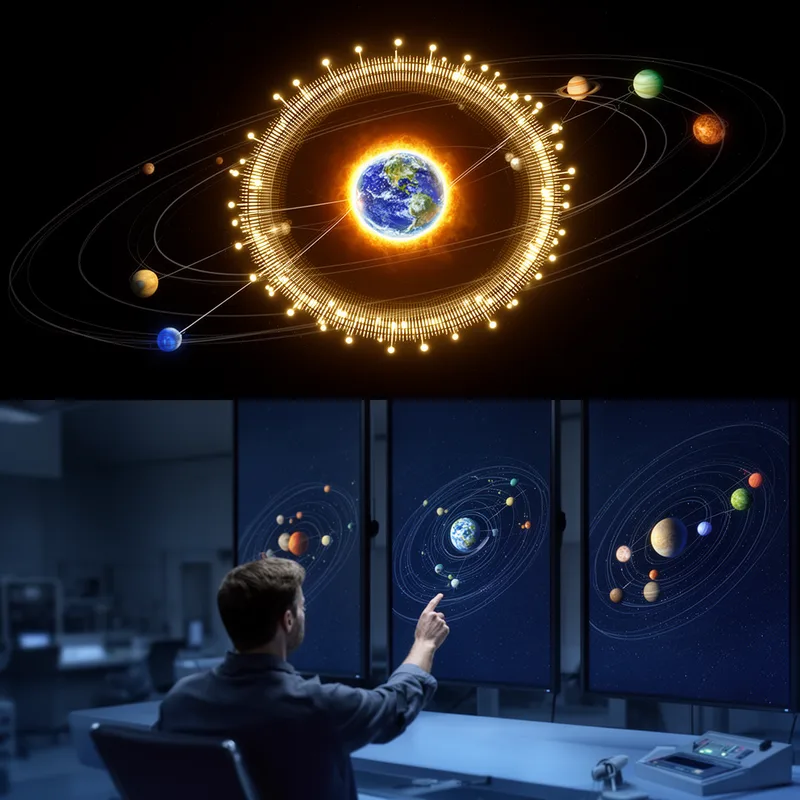
terrestrial dynamical time
- noun
- /tɛˈrɛstrɪəl daɪˈnæmɪkəl taɪm/
- Specialized
- The introduction of terrestrial dynamical time improved the accuracy of astronomical observations.
Examples
-
Modern astronomers use terrestrial dynamical time to calculate precise planetary positions.
-
Terrestrial dynamical time was eventually replaced by terrestrial time in astronomical calculations.
-
The concept of terrestrial dynamical time is crucial in astronomy.
-
Scientists often use terrestrial dynamical time for precise measurements.
-
Modern astronomers use terrestrial dynamical time to calculate precise planetary positions.
-
The introduction of terrestrial dynamical time improved the accuracy of astronomical observations.
-
Scientists often use terrestrial dynamical time for precise measurements.
Synonyms

 2
9.9
2
9.9

A precise time used by astronomers, based on Earth's orbit, to calculate planet positions


 1
9.0
1
9.0
A clock system that uses Earth's movement around the Sun and corrects for Earth's irregular motion
 1
9.9
1
9.9
A steady time based on Earth's motion used by astronomers and to guide spacecraft

Time measured by Earth's orbit, used for exact calculations of planet positions
Surface Forms
Morphology
terrestrial + dynamical + time
A learner who knows 'terrestrial' (Earth-related) and 'time' can infer this refers to a kind of time tied to the Earth, and the component 'dynamical' signals a relation to Earth's motions or dynamics. However, the phrase is a technical astronomical term whose precise sense (a specific timescale corrected for orbital variations) requires domain knowledge and the specialized meaning of 'dynamical', so the full meaning is not fully predictable from the parts alone.
Etymology
Terrestrial dynamical time comes from its parts: terrestrial ('Earth'), dynamical ('motion and forces'), and time. Imagine a clock that keeps time by watching how the Earth moves and changes, so the name means a 'measure of time' based on Earth's motion and small changes in that motion.