

ephemeris time
- noun
- /ɪˈfɛmərɪs taɪm/
- Archaic
- Before the adoption of atomic time, astronomers relied on ephemeris time for precise observations.
Examples
-
Astronomers often rely on ephemeris time for precise calculations.
-
The ephemeris time helps in predicting celestial events.
-
Accurate calculations of planetary positions depend on ephemeris time rather than solar time.
-
The concept of ephemeris time was introduced to address the irregularities in Earth's rotation.
-
Accurate calculations of planetary positions depend on ephemeris time rather than solar time.
-
Before the adoption of atomic time, astronomers relied on ephemeris time for precise observations.
-
The concept of ephemeris time was introduced to address the irregularities in Earth's rotation.
Synonyms

 2
9.9
2
9.9

A precise time used by astronomers, based on Earth's orbit, to calculate planet positions
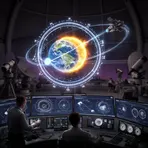

 1
9.9
1
9.9
A steady time based on Earth's motion used by astronomers and to guide spacecraft
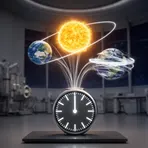 1
9.0
1
9.0
A clock system that uses Earth's movement around the Sun and corrects for Earth's irregular motion
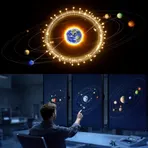
A time system based on Earth's orbit used to calculate planet positions
Surface Forms
Morphology
The noun is compositionally formed from 'ephemeris' (relating to celestial position tables) + 'time', so a learner who knows both words can infer it refers to the kind of time used for ephemerides. However, the precise technical sense — a uniform astronomical timescale based on orbital motion rather than Earth's rotation — is specialized and likely not predictable to a B1 learner, making the expression only partially transparent.
Etymology
The noun ephemeris time comes from old ephemeris tables where astronomers wrote the daily positions of the planets. They used the steady motion of the planets as a sky 'clock' because Earth's spin can change, so ephemeris time means time measured by the sky to give a steady 'time scale'.