
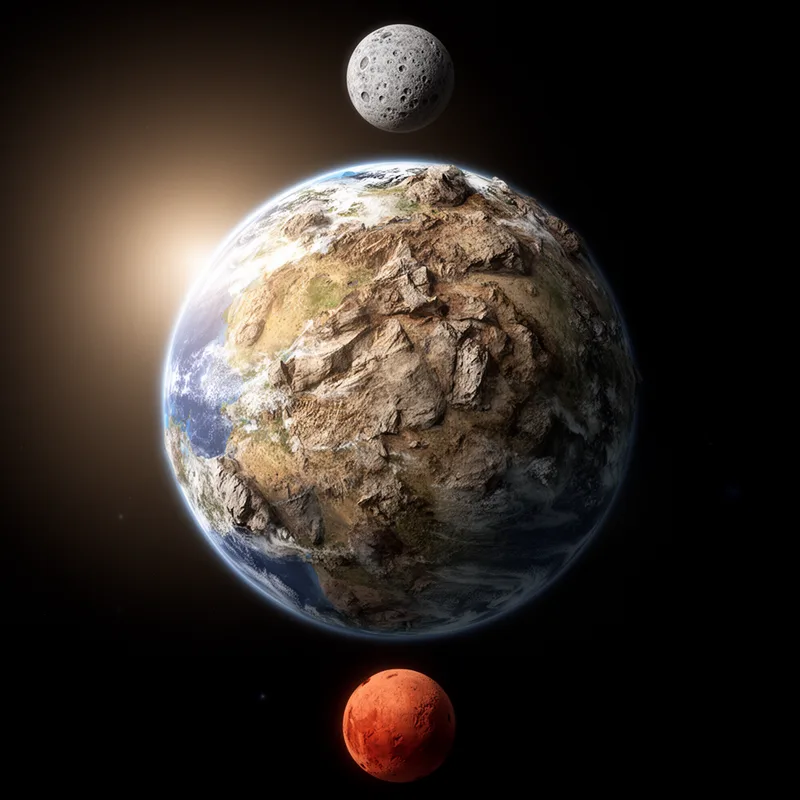
terrestrial planet
 1
4.1
1
4.1

- noun
- /tərˈɛstrɪəl ˈplænɪt/
- Specialized
- Mercury is the smallest terrestrial planet in our solar system, with no atmosphere to speak of.
- terrestrial planets like Earth
- terrestrial planets formed
Examples
-
The inner Solar System is home to the terrestrial planets—small, rocky worlds with thin atmospheres.
Academic text (2004) -
The scientists are studying how water may exist on a terrestrial planet like Mars.
-
And Venus is, despite being a terrestrial planet like Mars or Earth, it is very, very, very different from Earth.
-
Without that knowledge, we're not going to be able to really get a definitive theory on the formation and evolution of the terrestrial planets.
Academic text (2007) -
Venus and Earth are both terrestrial planets with solid surfaces and are similar in many ways.
Academic text (2004) -
Terrestrial planets like Earth form over a longer time period from solids left behind after the gas dissipates.
Academic text (2005) -
And then orbiting close to the sun are the terrestrial planets Mercury, Venus, Earth and Mars.
-
Venus and Earth are both terrestrial planets, meaning they have solid, rocky surfaces.
How Rocky
- Specialized
1
4.1

- Specialized
13
4.5
Surface Forms
Morphology
The meaning is directly compositional: 'terrestrial' (of or relating to the Earth/land) modifies 'planet' (a celestial body), so together they indicate a planet like Earth — i.e., a rocky/solid planet. This modifier+noun pattern is regular and cross-linguistically common, so a B1 learner who knows both constituents can reliably infer the intended meaning.
Etymology
Terrestrial planet comes from terrestrial, a word that means 'earth' or 'land', and planet, a body that moves around a star. The picture is a 'land' planet, so the term now means a planet with a solid, rocky surface like Earth.