
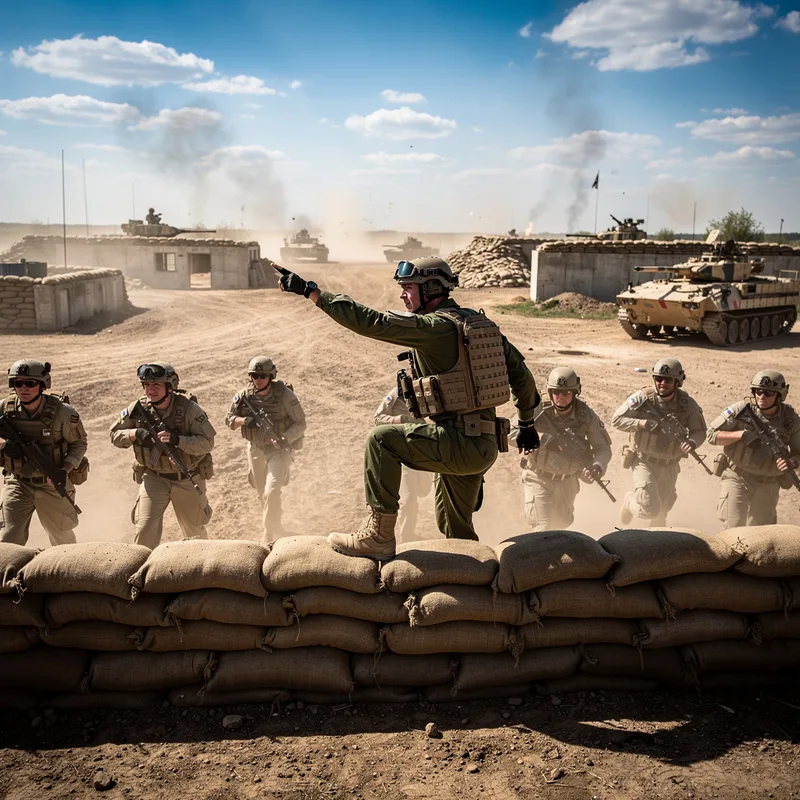
to take the offensive
 5
6.4
5
6.4

- idiom
 :
tomar la ofensiva
:
tomar la ofensiva
- Lincoln constantly prodded George McClellan to take the offensive in Virginia.
Examples
-
In his testimony, Young took the offensive at the outset and maintained it throughout his appearance.
Academic text (1997) -
Afraid of being rejected again, she took the offensive.
Fiction book (1992) -
At last we take the offensive.
-
The Church had to take the offensive.
Academic text (1993) -
Instead, he spoke and took the offensive.
Fiction book (1991) -
And he has taken the offensive on his remaining legal problems.
Blog text (12) -
The BBC has been playing defense at home, even as it tries to take the offensive outside the U.K.
Blog text (26) -
Such an institution might propose that the United States take the offensive abroad as well.
Academic text (1993) -
William Buckley, while on the defensive in Miami, may now take the offensive.
-
Since he had no choice but to fight, Napoleon decided to take the offensive.
Synonyms
 ∞
1.3
∞
1.3
To use force to hurt people or damage things
 316
6.1
316
6.1
To take part in fighting against an enemy
 182
4.2
182
4.2
To make a sudden, planned attack on an enemy or target
 56
6.7
56
6.7
Act with a lot of energy, often fighting, arguing, or working hard
 26
7.0
26
7.0
Act aggressively to get what you want when you compete with others
 16
7.7
16
7.7
Start fighting with weapons against an enemy or unfair rulers
 5
7.9
5
7.9
To begin fighting by using weapons against an enemy
 3
7.3
3
7.3
To take part in a fight or argument
 2
4.3
2
4.3
Start attacking someone strongly by shooting or with strong words


 1
8.8
1
8.8
Decide to respond with force or shouting instead of being peaceful
 1
8.8
1
8.8
To become suddenly aggressive and ready to fight back

Play aggressively to attack the other team rather than defend

To make a final move to win at an important moment
Antonyms


How Aggressive

Surface Forms
Morphology
The meaning is directly derivable from combining 'take' (to assume or adopt) with 'offensive' (attack-focused); a learner who knows these words can infer 'take the offensive' means to begin attacking or adopt an aggressive stance. The definite article does not change composition, and this construction has close parallels in many languages (e.g. French prendre l'offensive, Spanish tomar la ofensiva), supporting straightforward transparency for B1 learners.
Etymology
Take the offensive comes from soldiers who stopped defending and moved forward to take an offensive position to 'attack' the enemy. So, it now means 'to begin attacking' or to act boldly in a fight, argument, or competition.