
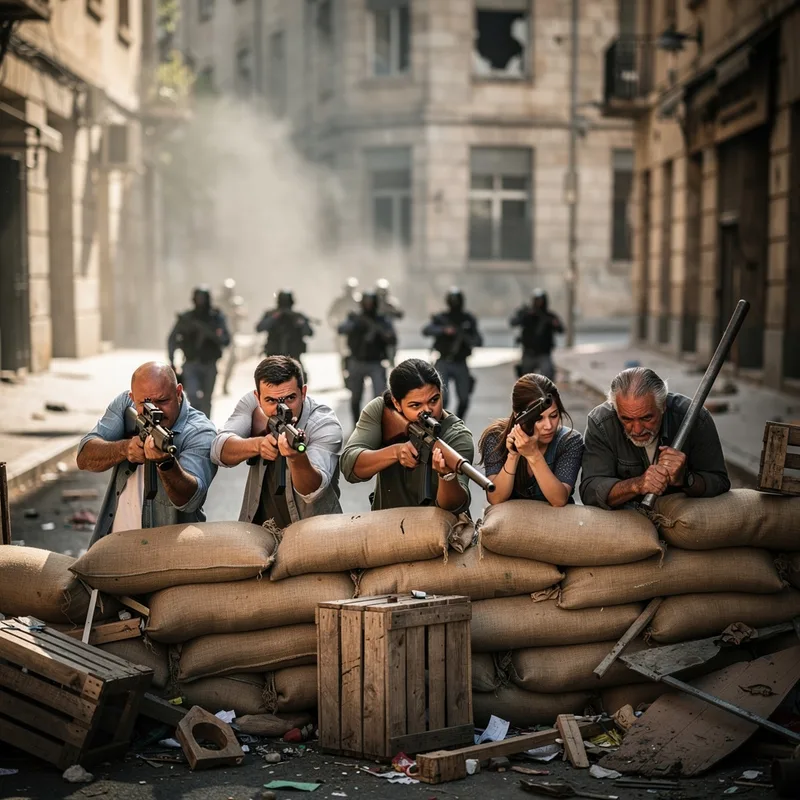
to take arms
 5
7.9
5
7.9

- phrasal verb
- /teɪk ɑrmz/
- In response to the oppressive regime, many groups chose to take arms and fight for their freedom.
Loading YouTube…
Watch on YouTubeOr at least take the damn oath that I took to understand what it means to say that you, you will have to take arms for the Constitution if asked to.
- Or at least take the damn oath that I took to understand what it means to say that you, you will have to take arms for the Constitution if asked to.
- And I wonder if each criminal thinks of himself as a revolutionary taking arms against what you're seeing says that society.
Examples
-
To protect their homeland, the villagers agreed to take arms against the approaching enemy forces.
-
Will you take arms against the king?
-
At 14 years old, she took arms against the French soldier.
-
At the same time, as the Mexican daily El Universal reports today, other hands have taken arms in the name of vigilante justice.
Blog text (7) -
Those citizens of the South whose consciences directed them to take arms against their home states faced a lose-lose decision.
Fiction book (1998) -
Today, we need a nation of Minutemen, citizens who are not only prepared to take arms, but citizens who regard the preservation of freedom as the basic purpose of their daily life and who are willing to consciously work and sacrifice.
Blog text (9) -
As Tecumseh's warriors took arms, the great Chieftain himself was heading north to join the fray At Brownstown Creek.
-
The citizens decided to take arms when they learned of the impending invasion.
Synonyms
 ∞
1.3
∞
1.3
To use force to hurt people or damage things
 274
3.4
274
3.4
To start fighting in a war between countries or groups
 16
7.7
16
7.7
Start fighting with weapons against an enemy or unfair rulers
 5
6.4
5
6.4
Begin attacking or acting aggressively to gain an advantage
Antonyms


How Combative

Surface Forms
Morphology
The meaning 'to begin fighting' is directly compositional from 'take' (to assume or seize) + 'arms' (weapons); a learner who knows both words can infer 'take up weapons' and thus the idea of preparing to fight. The construction has clear cross-linguistic parallels (e.g. 'tomar las armas') and is therefore immediately understandable to a B1 learner despite somewhat formal register.
Etymology
The verb take arms shows the simple image of people picking up arms, their 'weapons' like swords or guns, to get ready to fight. So, take arms means 'to begin fighting' or to prepare for battle.