

scleroderma
 3
9.9
3
9.9

- noun
- /ˌsklɛrəˈdɜrmə/
- Specialized
- Reduction in metal ions reduces inflammation caused by free radicals and makes chelation therapy helpful in arthritis, scleroderma, and lupus.
- scleroderma and lupus
Examples
-
In young patients, it is commonly hereditary, but after the second decade, its onset is often linked with underlying causes, particularly scleroderma and systemic lupus erythematosus.
Academic text (2007) -
MM is a 34-year-old female who has a 2-year history of systemic lupus erythematosus and scleroderma.
Academic text (1992) -
There was a family history of scleroderma.
Academic text (2007) -
I was diagnosed with scleroderma in 1994, but first noticed my symptoms in 1992.
Blog text (8) -
Scleroderma Jane's mother puts special lotion on her skin because she has scleroderma.
Academic text (2015) -
Serological tests for scleroderma and celiac sprue were negative.
Academic text (2007) -
You can use it transdermally to reduce inflammation, eczema, psoriasis, Scleroderma, all kinds of conditions of the skin.
-
Identical lesions have been described in cases of rheumatoid arthritis, lupus erythematosus, and scleroderma, and one case of Crohn's disease.
Academic text (2007) -
More surprisingly, there are even a few reports that cellulose may be a normal but small component of mammalian cells and that under certain disease conditions in humans, notably scleroderma, cellulose is produced in abundance (20).
Academic text (1993) -
Mia Johnson has been living with scleroderma for several years, which has caused thickening of her skin.
Synonyms

A long-term condition in which the immune system makes the skin hard and thick
Compounds

- Specialized
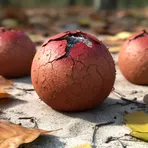
A round fungus with a hard brownish yellow skin covered in small warts and a dark purple inside
- Specialized
A round fungus like a puffball with a firm dry skin that cracks and turns reddish brown as it matures

- Specialized
A round brownish-yellow fungus covered in small bumps with a dark purple inside that is not edible

- Specialized
A round fungus with a smooth top that grows in sand and splits into ray-like segments
Surface Forms
Morphology
scleroderma = sclero + derma
The term is formed from medical Greek combining forms meaning 'hard' (sclero-) and 'skin' (derma), but these combining forms are technical and not recognizable to an average B1 learner, so the meaning is not transparently derivable.
Etymology
Scleroderma comes from Greek parts sclero- meaning 'hard' and -derma meaning 'skin'. So, scleroderma describes a condition where the skin becomes thicker and harder.