
Scleroderma citrinum
- noun
- Specialized
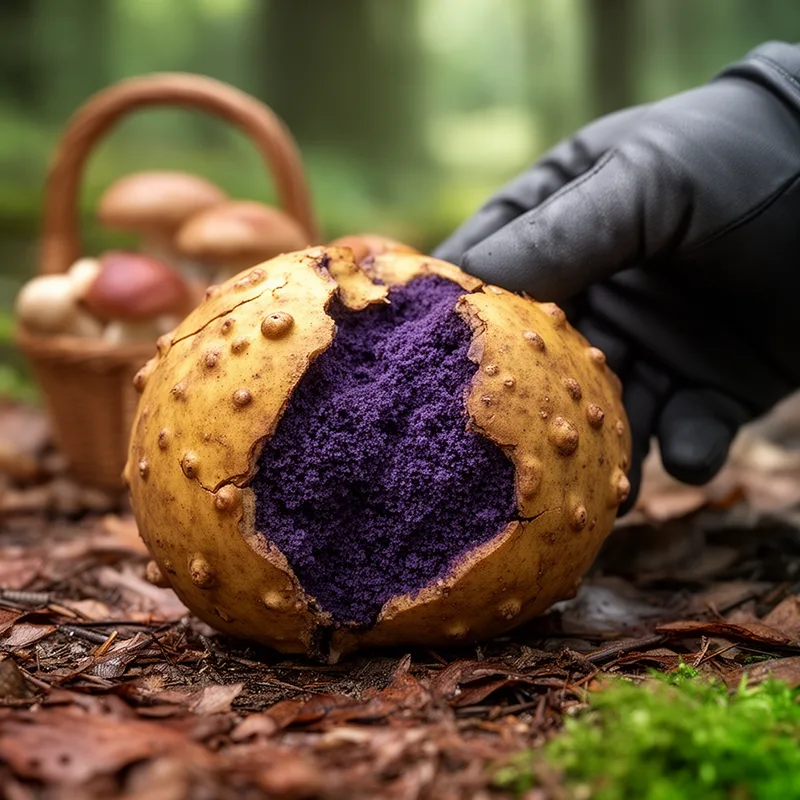
- Researchers identified the fungus as Scleroderma citrinum due to its dingy brownish-yellow outer layer and dark purplish interior.
Examples
-
Researchers identified the fungus as Scleroderma citrinum due to its unique warty peridium.
-
The forest floor was dotted with Scleroderma citrinum among the fallen leaves.
-
You should not eat Scleroderma citrinum as it is considered inedible or mildly toxic.
-
The Scleroderma citrinum is often found in forested areas.
-
Look at that Scleroderma citrinum!
-
On our hike, we spotted several examples of Scleroderma citrinum growing near the base of the trees.
-
The guide explained that Scleroderma citrinum is recognizable by its warty surface and is typically found in woodland areas.
Surface Forms
Morphology
Scleroderma + citrinum
Knowing 'Scleroderma' as a genus of fungi allows a learner to infer this is the name of a species in that genus, so the genus-species relation is transparent. However, 'citrinum' is a Latin epithet (not a standard English word and not defined here), so the specific descriptive sense (colour/texture) cannot be derived by a B1 learner; scientific binomials are therefore only partially compositional for general learners.
Etymology
Scleroderma citrinum comes from parts meaning 'hard skin' (Scleroderma) and 'lemon-yellow' (citrinum). This fits the round, warty fungus with a tough outer skin and a dingy brownish-yellow surface, so the name helps you remember how the fungus looks.

