

Scleroderma bovista
- noun
- /ˌsklɛrəˈdɜrmə boʊˈvɪstə/
- Specialized
- Scleroderma bovista has a smooth, pale orange-yellow exterior when it is young, which gradually turns reddish brown as it matures.
Examples
-
The outer skin of Scleroderma bovista cracks as the fungus matures, revealing the spore mass inside.
-
Mycologists warn that Scleroderma bovista should not be consumed due to potential toxicity.
-
Scleroderma bovista is commonly found in sandy soils during the autumn months.
-
Look at the Scleroderma bovista!
-
The Scleroderma bovista is often found in grassy areas.
-
Conservationists study Scleroderma bovista for its unique characteristics and habitat in sandy soils.
-
Due to its distinct appearance, Scleroderma bovista is often mistaken for other types of fungi.
Synonyms

A round fungus with smooth outer skin when young that cracks and darkens

A small mushroom with a hard outer skin that grows underground like a truffle
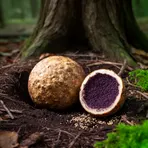
A round fungus with a hard skin that usually grows under the ground
Surface Forms
Morphology
Scleroderma + bovista
The phrase is a Latin binomial: knowing 'Scleroderma' signals a genus of fungi, so a learner who knows that can infer this refers to a kind of fungus, but the specific epithet 'bovista' is not a common English word and gives no transparent information about the detailed appearance or properties. Taxonomic names are specialized and the descriptive meaning in the definition cannot be derived from the constituents alone, so the expression is only partially predictable to a B1 learner.
Etymology
Scleroderma bovista comes from parts that mean 'hard' and 'skin' and from an old name for puffballs, with sclero-, derma, and bovista as the parts. One popular idea says the name paints a simple picture: a round fungus with a firm outer 'skin' that later cracks and shows the 'spores' inside, so the name describes its hard, ball-like body and how it opens.

