
Scleroderma flavidium
- noun
- Specialized
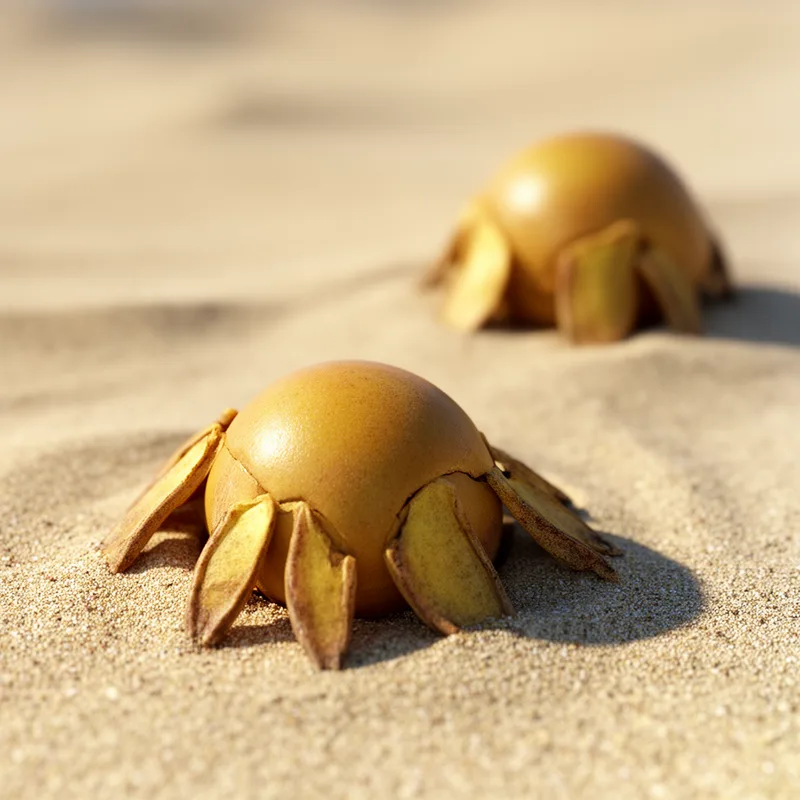
- When mature, the fruiting body of Scleroderma flavidium splits open in segments that resemble rays.
Examples
-
Mycologists observed the Scleroderma flavidium as it emerged from the sand, revealing its unique ray-like segments.
-
The rare Scleroderma flavidium was discovered growing beneath a layer of sand in the nature reserve.
-
Mycologists studied the Scleroderma flavidium to better understand its unique reproduction process.
-
Look at that Scleroderma flavidium!
-
The Scleroderma flavidium is often found in sandy soils.
-
In the nature reserve, researchers discovered a Scleroderma flavidium hidden beneath the sand, showcasing its smooth upper surface.
-
The Scleroderma flavidium is known for its distinct fruiting body that opens at the top, forming segments like rays.
Synonyms

A round mushroom that grows partly under sand and opens into star-shaped parts
Surface Forms
Morphology
Scleroderma + flavidium
The binomial combines the genus name Scleroderma (a fungus) with a Latin-looking epithet 'flavidium'; such epithets are typically descriptive (from Latin flavidus 'yellow'), so a learner who knows both constituents could infer 'a yellow species of Scleroderma'. However 'flavidium' is not an English word and is technical/Latin, so an average B1 learner who only knows the genus would not reliably derive the descriptive meaning, making the transparency partial.
Etymology
Scleroderma flavidium is a fungus that looks like a hard round ball hidden under sand and, when it is ready, the top splits open into ray-like pieces like a small sun. So imagine a 'buried' ball 'opening' into 'rays' to remember this species' look.

