

saprophytic organism
- noun
- /ˌsæprəˈfɪtɪk ˈɔrɡənɪzəm/
- Specialized
- After an animal dies, a saprophytic organism helps decompose its remains.
Examples
-
Many mushrooms are classified as a saprophytic organism because they feed on decaying wood.
-
A saprophytic organism helps decompose dead plants.
-
A saprophytic organism plays an essential role in breaking down dead leaves in the forest.
-
Many saprophytic organisms thrive in dark, moist environments.
-
The saprophytic organism decomposes dead leaves, returning essential nutrients to the soil.
-
A mushroom is a type of saprophytic organism that thrives on decaying wood.
-
In the forest, a saprophytic organism plays an important role by breaking down dead plants and animals.
Synonyms

 19
4.1
19
4.1

An animal that eats dead animals or plants


 1
9.9
1
9.9
A living thing, often a fungus, that eats dead plants or animals
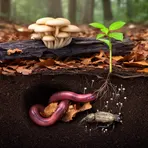
An organism like a fungus or worm that breaks down dead plants and animals and returns nutrients to the soil

A plant, fungus, or animal that feeds on dead plants and animals

A living thing such as mushrooms or bacteria that feeds on rotting plants and animals
Surface Forms
Morphology
The noun phrase is fully compositional: 'saprophytic' specifies the nutritional mode (obtaining nutrients from decomposing matter) and 'organism' names the living entity, so the combined meaning is a living thing that feeds on decay. This follows a standard adjective + noun composition, so a learner who already knows both constituent words can derive the MWE's meaning.
Etymology
The term saprophytic organism comes from older words meaning 'rotten' and 'plant', and it creates the picture of a saprophytic living thing feeding on decaying material. So, a saprophytic organism is an organism that gets its food from dead plants or animals.