
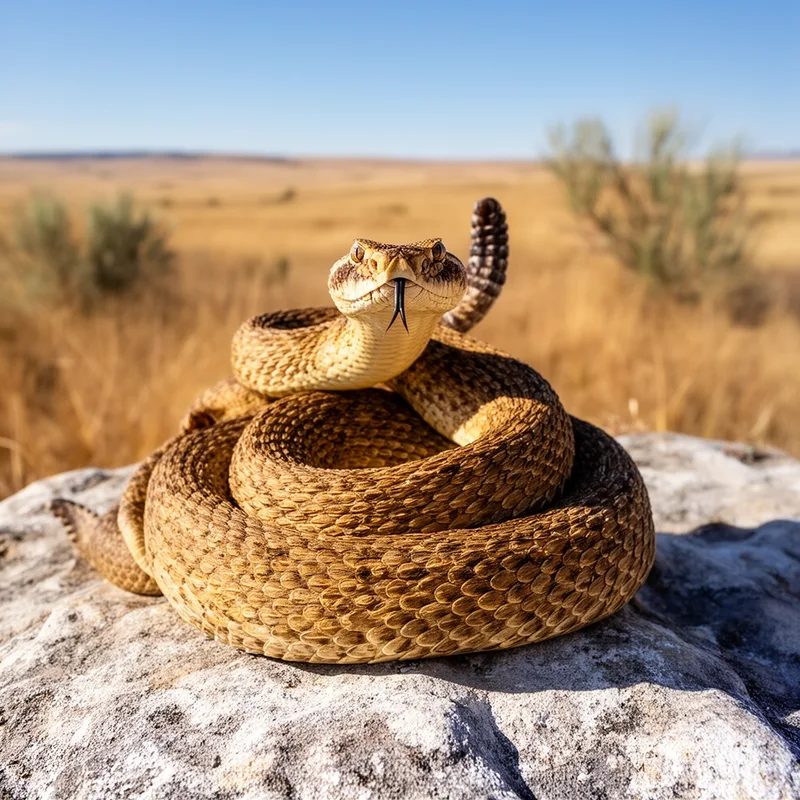
prairie rattlesnake
- noun
- /ˈprɛəri ˈrætəlˌsneɪk/
- US
- Researchers tracked the movement of a single prairie rattlesnake over the course of the summer.
Examples
-
The prairie rattlesnake is known for its distinctive rattle.
-
The prairie rattlesnake uses its rattle as a warning to ward off potential threats.
-
Much of eastern Colorado is home to the prairie rattlesnake, which often basks on rocky outcrops.
-
Many prairie rattlesnakes can be found in the Great Plains.
-
While hiking in the grasslands, I saw a prairie rattlesnake basking in the sun, waiting for its next meal.
-
The prairie rattlesnake is known for its distinctive rattle and can be found across various grassland regions.
-
After hearing the warning rattle, we carefully stepped back to avoid provoking the prairie rattlesnake.
Synonyms
A venomous snake, the prairie rattlesnake, that lives in grasslands between the Mississippi River and the Rocky Mountains
A venomous snake with a rattle on its tail that lives in western North America
A venomous rattlesnake that lives in grasslands of central North America
How Dangerous


 1
4.6
1
4.6

- US
Surface Forms
Morphology
The noun compound is fully compositional: 'prairie' (grassland) modifies 'rattlesnake' (a snake with a rattle), so the phrase denotes a rattlesnake associated with prairies. A B1 learner who knows both words can readily infer this habitat-specific species meaning, and this modifier-noun pattern is cross-linguistically common.
Etymology
The noun prairie rattlesnake comes from two simple images: prairie is the wide grassland where it lives, and rattlesnake points to its tail that makes a loud rattle. That rattle is used as a 'warning', so the name means a venomous snake of the prairie that warns others before it bites.