
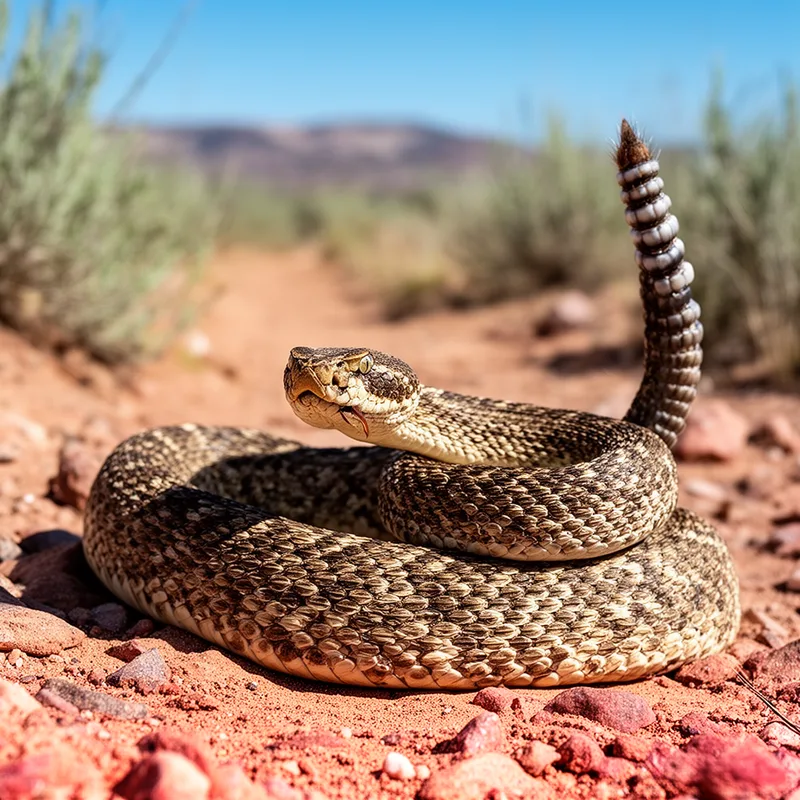
Western rattlesnake
- noun
- /ˈwɛstərn ˈrætəlˌseɪk/
- US
- Hikers in the region are warned to watch for the Western rattlesnake along rocky trails.
Examples
-
The Western rattlesnake is known for its distinctive rattle.
-
The Western rattlesnake relies on its camouflage to avoid predators and surprise prey.
-
Scientists are tracking the migration patterns of the Western rattlesnake across its native range.
-
Many Western rattlesnakes can be found in the deserts of Arizona.
-
In the desert, a Western rattlesnake coiled up to warn us with its distinctive rattle.
-
During our hike, we spotted a Western rattlesnake basking in the sun on a rock.
-
The Western rattlesnake is known for its striking patterns and potent venom.
Synonyms
A venomous rattlesnake that lives in grasslands of central North America
A venomous snake with a rattle that lives in dry grasslands in central North America
A venomous snake, the prairie rattlesnake, that lives in grasslands between the Mississippi River and the Rocky Mountains
Surface Forms
Morphology
The phrase combines a clear locational adjective 'western' (from the west) with the noun 'rattlesnake' (a snake with a rattling tail), so a learner who knows both words can infer it refers to a rattlesnake species/individual found in western regions. This is a straightforward adjective + noun composition common across languages and not idiomatic, so its meaning is immediately derivable from the constituents.
Etymology
The name Western rattlesnake comes from two parts: western for the area it lives in and rattlesnake because it has a tail 'rattle' that it shakes as a 'warning'. That's why the name describes a venomous snake with a noisy tail that lives in the western part of North America.

