
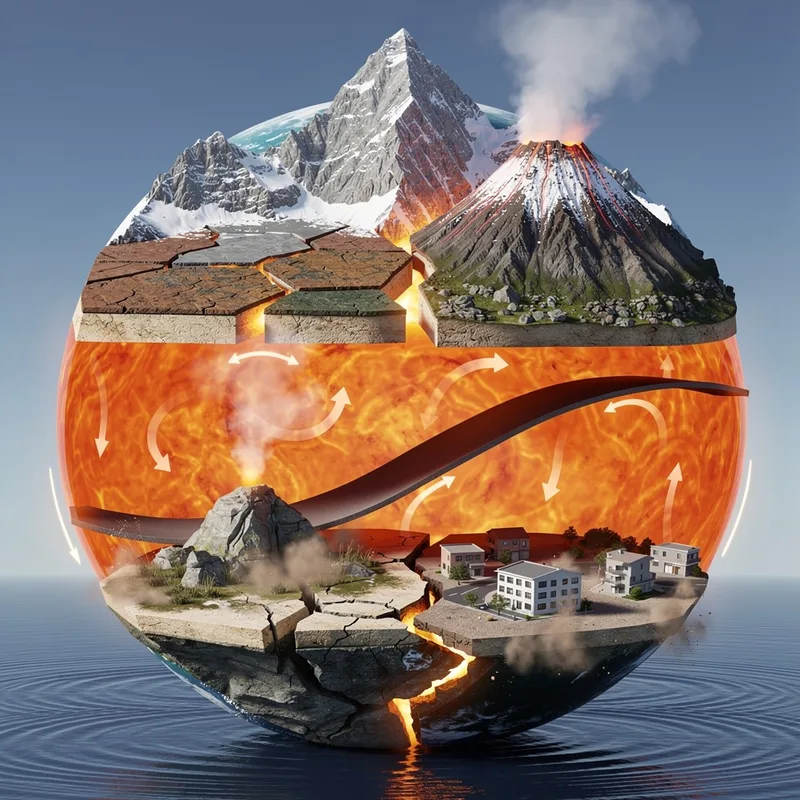
plate tectonics
 5
3.9
5
3.9

- noun
- /pleɪt tɛkˈtɒnɪks/
- Specialized
- On Earth, plate tectonics is responsible for most of the cooling of the still-hot interior.
- theory of plate tectonics
- Plate tectonics operates
- Plate tectonics on Earth
Examples
-
Researchers study plate tectonics to understand phenomena like mountain formation and continental drift.
-
According to this model, plate tectonics ceased about 500 million years ago, accompanied by global catastrophic resurfacing.
Academic text (1995) -
So plate tectonics is thought to occur only on Earth.
-
A topic that integrated science with real life well is plate tectonics.
Academic text (2002) -
For millions of years to come, plate tectonics will continue to be the main mechanism for heat loss from our planet.
Academic text (1995) -
There is no evidence for plate tectonics on Venus.
Academic text (1995) -
We haven't yet found evidence for Earth-like plate tectonics, nor have we found any evidence for ancient oceans or running water.
Academic text (1991) -
Today, plate tectonics, which explains continental drift, is a full-fledged physical theory with abundant observational support.
Academic text (1990) -
Earthquakes and volcanoes are inexorably linked through plate tectonics, with the major seismic and volcanic belts concentrated along the boundaries between plates.
Academic text (2002) -
The theory of plate tectonics explains how Earth's lithospheric plates move and interact, causing earthquakes.
Synonyms
 8
6.5
8
6.5
The study of how the Earth's outer layer moves and changes
A scientific idea that Earth's outer layer of rock moves in large plates and causes earthquakes, volcanoes and mountains

The study of the Earth's outer layer of rock and how it moves and forms features
The study of forces that shape Earth's structure and cause its movement

A process in which movements inside the Earth form and change the Earth's crust
Surface Forms
Morphology
The meaning is directly compositional: 'plate' specifies the lithospheric slabs and 'tectonics' denotes the study/science of structural movement, so together they transparently denote the theory of plate movements. This is a standard scientific noun-noun compound with clear cross-linguistic equivalents (e.g. French 'tectonique des plaques', Spanish 'tectónica de placas'), making it predictable to a learner who knows the constituents.
Etymology
Plate tectonics comes from the picture of the Earth's surface as large, hard pieces called plates that slowly 'move' like pieces of a floating puzzle. The word tectonics points to building and pushing, so when these plates push or pull each other they make 'earthquakes' and mountains, which is why the term describes the movement of those plates.