
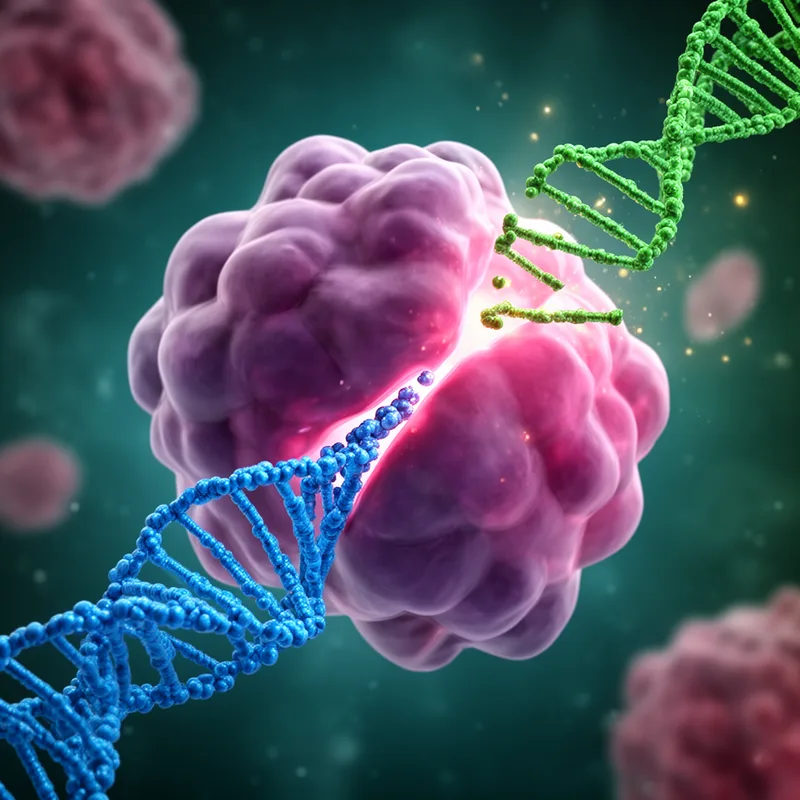
nuclease


 1
8.8
1
8.8
- noun
- /ˈnjuːkleɪs/
- Specialized
- Antisense oligonucleotides (ASO) that mimic naturally occurring RNA/DNA are highly unstable and are very rapidly degraded by nucleases.
Loading YouTube…
Watch on YouTubeThese include zinc finger nucleases and Talon proteins.
- These include zinc finger nucleases and Talon proteins.
Examples
-
Figure 5 is a time-lapse sequence showing the digestion of a DNA fragment by Bal 31 nuclease.
Academic text (1995) -
In the first clinical application of genomic editing, a related genome editing technique (using a zinc finger nuclease) was used to create HIV-1 resistance in human immune cells, bringing the HIV viral load down to undetectable levels in at least one individual.
Academic text (2017) -
The first image was taken just before the addition of the nuclease, and the other images were taken 12 and 24 minutes after the addition of nuclease.
Academic text (1995) -
The nuclease is not seen because it interacts only transiently with the DNA during catalysis.
Academic text (1995) -
DNA fragments between 100 bp and 500 bp were precipitated and dissolved in nuclease-free H2O.
Academic text (2017) -
The scientist used a nuclease to break down the DNA into smaller fragments for analysis.
-
Researchers studied the effect of a specific nuclease on the genetic material of various organisms.
-
The laboratory developed a new nuclease that improves gene editing techniques significantly.
Compounds

How Specific

Surface Forms
Morphology
nuclease = nucleus (semi-transparent) = nucle + ase
The combining form 'nucle-' relates to 'nucleus', but '-ase' is a technical enzyme suffix; the enzymatic meaning is specialized and may not be obvious to general learners.
Etymology
Nuclease comes from the Latin nucleus, which means 'kernel' or 'nut', plus the enzyme ending -ase. So, a nuclease is an enzyme that 'breaks' the kernel of nucleic acids, which is why it cuts DNA or RNA into smaller pieces.