
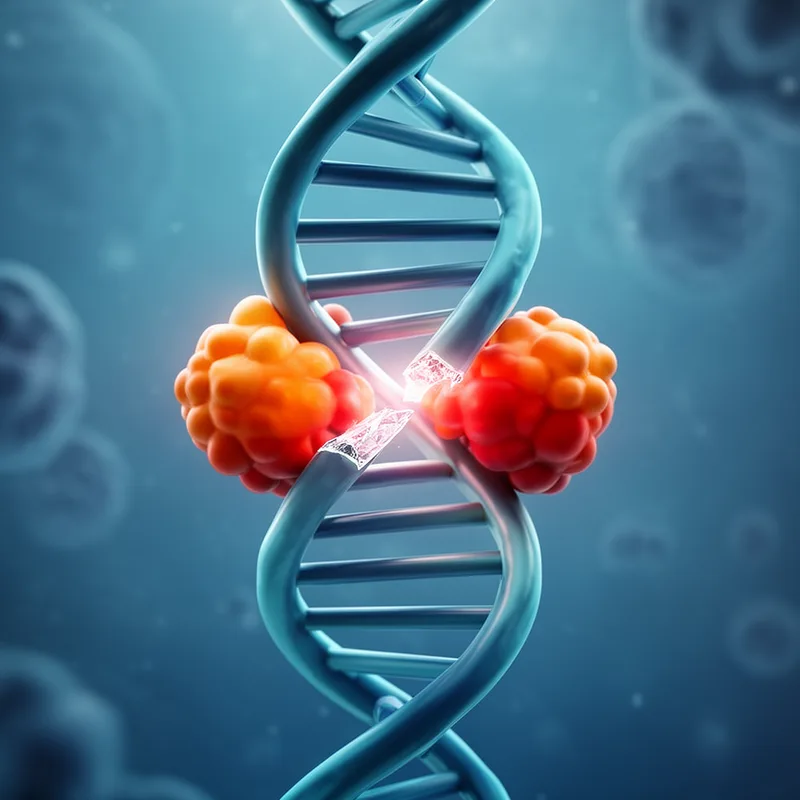
endonuclease


 1
9.9
1
9.9
- noun
- /ˌɛndəˈnuːkleɪs/
- Specialized
- In brief, this PCR-based method amplifies fragments from the DNA of a single individual on the basis of the presence or absence of short sequences (recognized by restriction endonucleases) at hundreds of sites across the genome (see panel b; Vos et al. 1995).
- restriction endonuclase
- endonuclase analysis
Loading YouTube…
Watch on YouTubeLet's start off by talking about blunt restriction endonucleases and blunt ends after restriction enzyme or endonuclease cutting.
- Let's start off by talking about blunt restriction endonucleases and blunt ends after restriction enzyme or endonuclease cutting.
Examples
-
The endonuclase cleaves the DNA at specific sequences, facilitating the study of genetic mutations.
-
Researchers use endonuclase enzymes to manipulate genetic material for various biotechnological applications.
-
So you may or may not regenerate A restriction endonuclease site.
-
So there's an AP endonuclease that recognizes that AP site, the site without the base.
-
And there's a type of endonuclease, and these are called restriction endonucleases.
-
Any incoming foreign DNA is recognized as non-self by this restriction endonuclease and is destroyed.
Academic text (1993) -
Assembly of human RISC minimally requires AGO2, DICER, and TRBP, among which AGO2 is the catalytic engine owing to its endonuclease activity, and the DICER-TRBP complex acts simply as a platform.
Blog text (18) -
Restriction endonuclase enzymes are essential for molecular cloning as they allow scientists to cut DNA into specific fragments.
Synonyms
 1
8.8
1
8.8
A protein that cuts DNA or RNA into smaller pieces
Compounds
- Specialized
An enzyme that cuts DNA at a specific sequence to make small pieces
How Specific

Surface Forms
Morphology
endonuclease = nuclease (transparent) = endo + nucle + ase
Formed by productive prefixation of 'endo-' onto the existing English base 'nuclease'; the meaning is directly derivable as an enzyme that cleaves internal bonds of nucleic acids.
Etymology
Endonuclease joins the prefix endo- meaning 'within', as in endoscope, and nuclease, which comes from nucleus meaning 'center'. So an endonuclease is an enzyme that cuts DNA or RNA 'inside' the molecule rather than at the ends.