
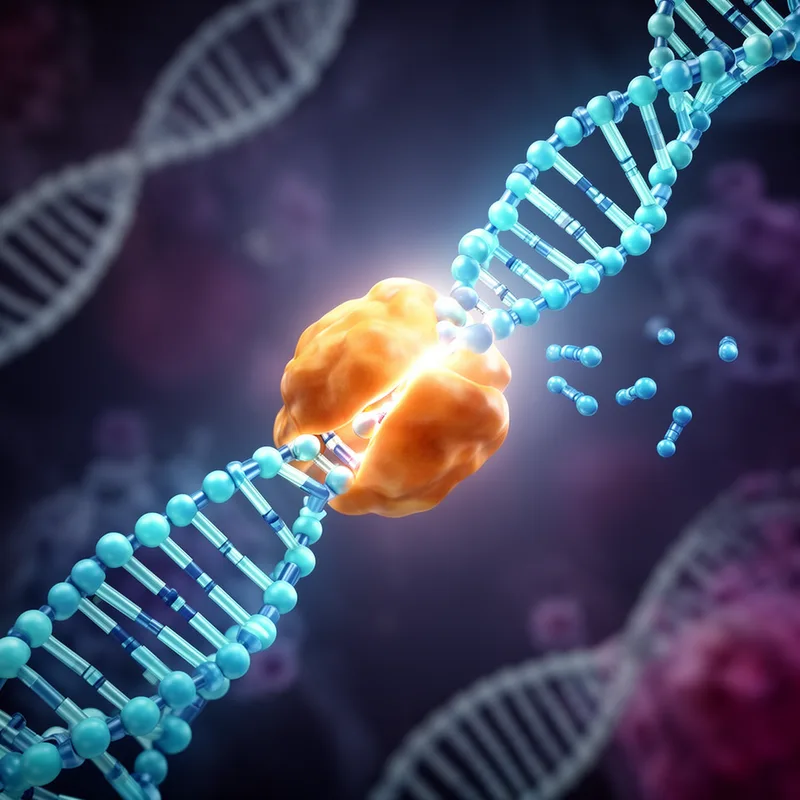
restriction endonuclease
- noun
- /rɪˈstrɪkʃən ˌɛndəˈnuːkleɪs/
- Specialized
- You can look through books of restriction endonucleases and you can find something that cuts exactly where you want it to in the DNA.
- restriction endonuclease analysis
Examples
-
The laboratory utilized a restriction endonuclease to generate defined DNA fragments for analysis.
-
Any incoming foreign DNA is recognized as non-self by this restriction endonuclease and is destroyed.
Academic text (1993) -
So you may or may not regenerate A restriction endonuclease site.
-
In brief, this PCR-based method amplifies fragments from the DNA of a single individual on the basis of the presence or absence of short sequences (recognized by restriction endonucleases) at hundreds of sites across the genome (see panel b; Vos et al. 1995).
Academic text (2009) -
Restriction endonuclease enzymes are crucial for cutting DNA at specific sequences during genetic engineering experiments.
-
Scientists often use a restriction endonuclease to precisely cut DNA molecules for cloning purposes.
Synonyms

 1
5.8
1
5.8

An enzyme that cuts DNA at specific short sequences used in research with genes

A protein that cuts DNA at certain places
How Specific


Surface Forms
Morphology
Knowing 'endonuclease' (an enzyme that cleaves internal nucleic acid bonds) plus 'restriction' (a limiting or specific property) lets a learner infer this is an endonuclease with a restrictive/specific activity — i.e. an enzyme that cuts DNA at particular sites. However, the precise notion of recognition sequences and the specialized biological sense of 'restriction' is domain-specific and not fully predictable from everyday meanings, so the relation is only partially transparent.
Etymology
Restriction endonuclease comes from a clear image: bacteria use these enzymes to 'restrict' (stop) invading virus DNA by cutting it at certain spots, and endonuclease means an enzyme that cuts inside a DNA strand. So the name shows it is a protein that 'cuts' DNA at precise places.