

restriction enzyme
 1
5.8
1
5.8

- noun
- /rɪˈstrɪkʃən ˈɛnzaɪm/
- Specialized
- DArT arrays are constructed using a library of amplified restriction enzyme-digested DNA fragments.
- restriction enzyme-digested DNA
- restriction-enzyme analysis
Loading YouTube…
Watch on YouTubeUsually you cut your vector with the same restriction enzyme or enzymes that you've cut your gene of interest with.
- Usually you cut your vector with the same restriction enzyme or enzymes that you've cut your gene of interest with.
- Let's start off by talking about blunt restriction endonucleases and blunt ends after restriction enzyme or endonuclease cutting.
Examples
-
Separate PCR products were studied by restriction-enzyme analysis with two different enzymes.
Academic text (1991) -
Beclin 1-T2A was cloned into the AAV backbone using the restriction enzymes ClaI and EcoRI.
Academic text (2018) -
Special enzymes called restriction enzymes are used to cut the DNA at specific places.
Academic text (1995) -
It'll cut the DNA, using what are called restriction enzymes.
Fiction book (1990) -
Restriction-enzyme analysis with Hae III was used for the initial screening of tumors.
Academic text (1991) -
And so this particular restriction enzyme here recognizes this sequence GAATTC.
-
First, the total genomic DNA is cut with a restriction enzyme, leaving DNA fragments with a sticky overhang of two bases.
Academic text (2010) -
All of the identified mutations were confirmed by additional restriction-enzyme analysis with Hae III and Plel (fig I).
Academic text (1991) -
Finally, incubation of PCR products with Sau3AI restriction enzyme at 37°C for 15 minutes was performed to determine the genotypes.
Academic text (2015) -
Special enzymes called restriction enzymes are used to cut the DNA at specific places.
Synonyms
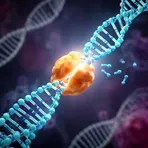
An enzyme that cuts DNA at a specific sequence to make small pieces

A protein that cuts DNA at certain places
How Specific


Surface Forms
Morphology
The compound is partially compositional: a B1 learner who knows 'restriction' (a limit) and 'enzyme' (a protein catalyst) can infer it denotes an enzyme related to 'restriction' or limiting activity. However, the precise, technical sense — an enzyme that cuts DNA at specific sequences — is domain-specific and not directly derivable from the common meanings, so the relation is only partially predictable.
Etymology
Restriction enzyme comes from bacteria that make an enzyme to restrict invading viruses by cutting their DNA at certain spots. Scientists used that image—an enzyme that cuts DNA at specific places—so today restriction enzymes are the tools we use to cut DNA in genetic research.