

restriction nuclease
- noun
- /rɪˈstrɪkʃən ˈnjuːkleɪs/
- Specialized
- A restriction nuclease cuts DNA at specific sequences, producing fragments for analysis.
Examples
-
Scientists used a restriction nuclease to cut the DNA into smaller fragments for analysis.
-
Modern cloning techniques rely heavily on the precision of restriction nucleases.
-
A restriction nuclease recognizes and cleaves at a specific sequence within the genome.
-
The restriction nuclease cut the DNA at specific sites.
-
Many researchers rely on restriction nucleases for their experiments.
-
Scientists often use a restriction nuclease to prepare DNA samples for cloning.
-
The experiment demonstrated how a restriction nuclease can create distinct DNA fragments.
Synonyms

 1
5.8
1
5.8

An enzyme that cuts DNA at specific short sequences used in research with genes


 1
9.9
1
9.9
A protein that cuts inside DNA or RNA molecules
 1
8.8
1
8.8
A protein that cuts DNA or RNA into smaller pieces
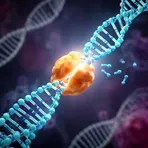
An enzyme that cuts DNA at a specific sequence to make small pieces
How Specific

Surface Forms
Morphology
The meaning is directly compositional: 'nuclease' denotes an enzyme that cleaves nucleic acids and 'restriction' qualifies it as a specific/limiting type of nuclease, so a learner who knows both words can infer an enzyme that cuts nucleic acids at particular sites. Although technical, the modifier+noun structure follows regular compounding patterns (and similar terms exist in other languages), so the sense is transparent to learners who know the constituents.
Etymology
Restriction nuclease gives a simple image: nuclease is like tiny scissors that 'cut' DNA, and restriction means those scissors only work at certain 'restricted' spots, like a barcode on the strand. So a restriction nuclease is an enzyme that 'cuts' DNA at specific places to make precise fragments used in labs.