

to mark out
 4
4.0
4
4.0

- phrasal verb
- The workers need to mark out the area for the new playground using bright spray paint.
- marks out a boundary
- mark out a place
Loading YouTube…
Watch on YouTubeAnd I like to just say mark out that spot.
- And I like to just say mark out that spot.
- So an oncologist will look at each slice in the CT scan and mark out by hand where the tumor is.
- So I think I'm going to mark out, poke a hole and pray, and we're going to see if we can find the tape in there.
Examples
-
OK, so we marked out our entire grid in pencil.
-
So an oncologist will look at each slice in the CT scan and mark out by hand where the tumor is.
-
"We need to know what the scale is, and no one will mark out the field."
Blog text (26) -
Now what I want to do is mark out these holes.
-
Now, the next step after you got here is to mark out where you want to drill.
-
I'm going to mark out some handle positions.
-
The dance ground had been cleared, and a circle had been marked out.
Fiction book (1995) -
Here's Benjamin helping to mark out the pathway and stop right there.
-
The racetrack oval was still marked out in the grass.
Fiction book (1994) -
First, we'll mark out a wide perimeter, then we'll start combing the outlying streets.
Synonyms
 252
1.0
252
1.0
To make the shape or edges of something clear
 65
3.2
65
3.2
To draw the outer edge of something
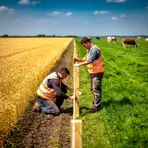 4
7.9
4
7.9
To mark the border between two areas with a line or fence
 2
7.0
2
7.0
To draw the shape or edge of something clearly
 1
3.9
1
3.9
To show the line that separates two places
 1
7.0
1
7.0
To mark the edges of an area or idea
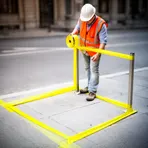

 1
3.4
1
3.4
To draw lines or put tape to show the edge of an area
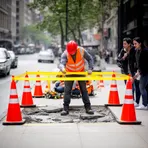
To show the limits of something, for example an area or duties

Set or mark the limits of an area like a project

To make a clear line between two areas or kinds of activity
Antonyms

How Defined

Surface Forms
Morphology
The meaning 'to set boundaries or clearly delimit' is clearly related to 'mark' (to label or indicate) combined with the particle 'out' suggesting an outward/outline function, so a learner who knows both words can often infer the general sense. However, the specific delimiting nuance depends on knowledge of the phrasal-verb particle use rather than straightforward compositional semantics, so it is not fully transparent.
Etymology
Mark out comes from the simple act of putting visible marks to show the edges of a space. Imagine drawing lines or placing stakes to show the outside edge: you are making a mark to show what is out, so the area is clear, and that is why it means 'to set boundaries for'.