
to demarcate
 4
7.9
4
7.9

- verb
- /dɪˈmɑrkˌeɪt/
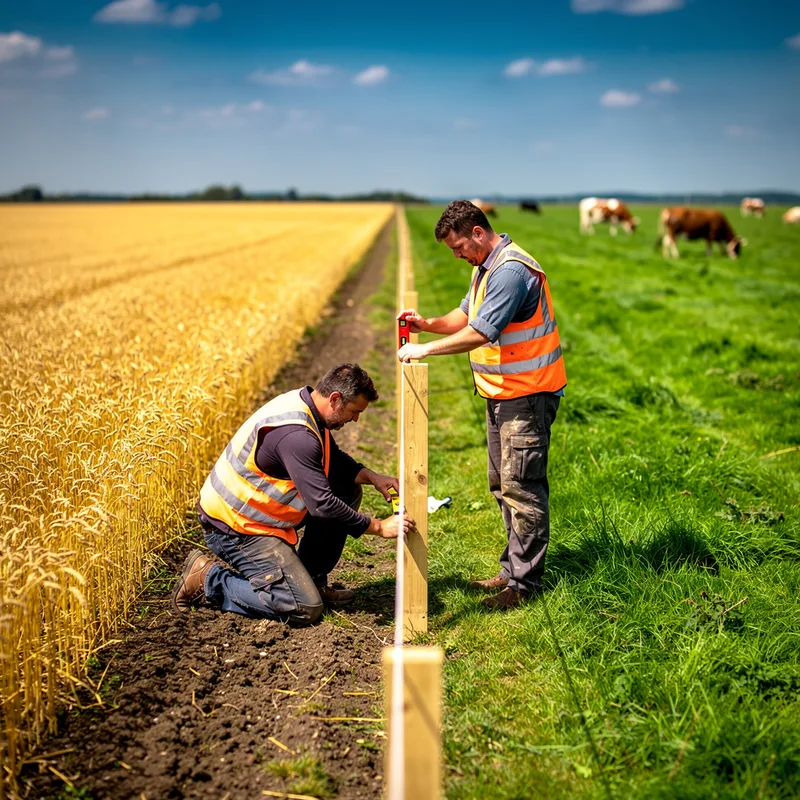
- The surveyor used flags to demarcate the property lines between the two houses.
- demarcated boundaries
- demarcated territory
- demarcated space
Loading YouTube…
Watch on YouTubeCities were always clearly demarcated between town and country.
- Cities were always clearly demarcated between town and country.
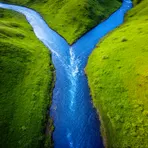
- And they crossed the river, which typically demarcates their territory.
- It's actually what you put in between and it demarcates your own space.
- We use them as tools, as intellectual devices for demarcating what something is and what it isn't.
- They're putting on war paint to make themselves more ferocious or to demarcate what tribe they're in, what coalition they're in.
- Think of other ways that we can demarcate categories in the classroom and not base those only on sex.
- The way they clearly demarcate themselves from the states or the soup in which they are immersed.
- The where they clearly demarcate themselves from the states or the soup in which they are immersed.
Examples
-
Smaller constituencies can be demarcated in areas where the ruling party commands concentrated support.
Academic text (1998) -
I use these years as benchmarks because they demarcate two critical historical moments of change.
Academic text (2008) -
Think of other ways that we can demarcate categories in the classroom and not base those only on sex.
-
Cities were always clearly demarcated between town and country.
-
In what follows, we demarcate what geographers have written on drugs and what more can be done.
Academic text (2013) -
And they crossed the river, which typically demarcates their territory.
-
The front of this space is demarcated by a prominent lip connecting the structures.
Academic text (2012) -
The path led to the front of the building and a clearing demarcated by an oriental screen.
Fiction book (1999) -
U.S. farms are seen as analogous to factories and are sharply demarcated from wilderness and nature conservation areas.
Academic text (1999) -
Anthropologists have frequently noted the importance of foodways in demarcating ethnic and other group identities.
Academic text (1999)
Synonyms
 252
1.0
252
1.0
To make the shape or edges of something clear
 8
3.8
8
3.8
Set a clear limit on what is acceptable
 4
4.0
4
4.0
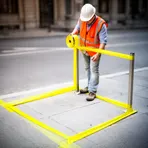
Show the edges of an area, for example with string or chalk
 2
7.0
2
7.0
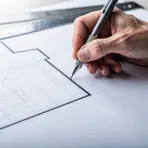
To draw the shape or edge of something clearly
 1
3.9
1
3.9
To show the line that separates two places
 1
7.0
1
7.0
To mark the edges of an area or idea

 1
3.4
1
3.4
To draw lines or put tape to show the edge of an area
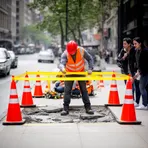
To show the limits of something, for example an area or duties

Set or mark the limits of an area like a project

To make a clear line between two areas or kinds of activity
Antonyms
How Precise

Surface Forms
Morphology
Etymology
Demarcate comes from the parts de- and mark, where de- means 'off' and mark means 'a sign' or 'boundary'. So to demarcate is to 'mark off' an area or set clear limits, which is why you demarcate property lines or lanes.