
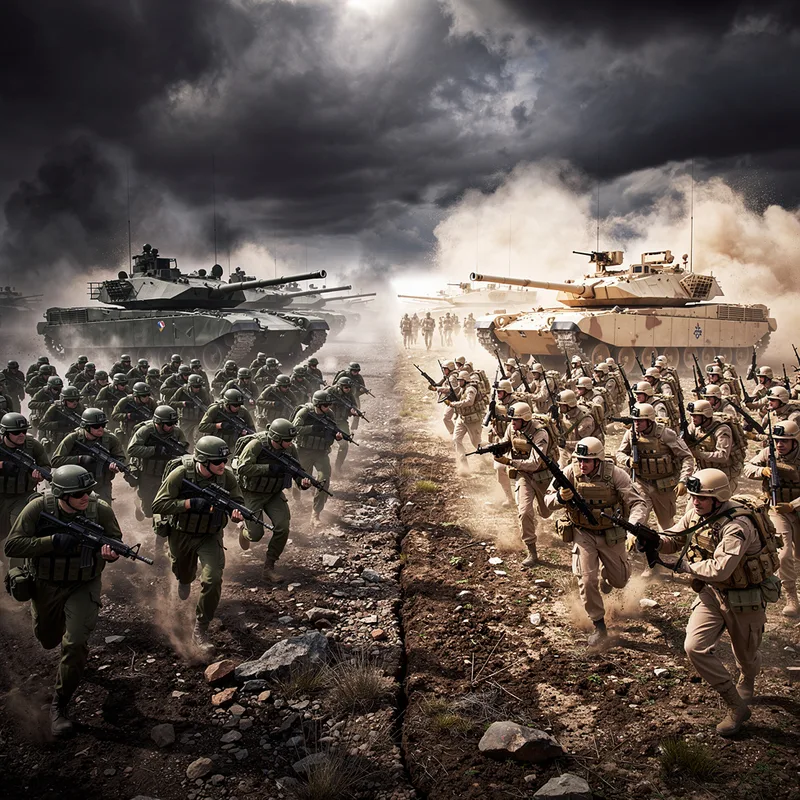
to go to war
 274
3.4
274
3.4

- phrasal verb
- /ɡoʊ tə wɔr/
- After much debate, the leaders decided to go to war to defend their territory.
- decision to go to war
- go to war to protect
- states go to war
Loading YouTube…
Watch on YouTubeHe's he's gone to war with the virus.
- He's he's gone to war with the virus.
- Sviatopolk then goes to war against Yaroslav.
- And they invaded or they went to war against the Jewish homeland.
- He says, we've made the decision we're going to war with Iraq.
- I would say you don't go to war to end all war.
- It's very unusual for the countries we cover to go to war with us.
- Oh my God, we're going to war with India now.
- All armies went to war with different kinds of fuses, right?
- I didn't want to go to war, not being on the best team.
- You just put your head down and you go to war until you find out.
- You join the teams to go to war, most, most of us.
- Only the men will go to war, and the other way around.
- And he goes on to say that he will go to war over this.
- Men going to war tend to leave their women behind.
Examples
-
It means you have to go to war.
-
We're about to go to war.
-
You just put your head down and you go to war until you find out.
-
Oh my God, we're going to war with India now.
-
I never wanted to go to war.
-
But the sole focus of the military is to go to war and win wars.
-
Nations that share a religion are perfectly capable of going to war against each other.
Academic text (2000) -
Our sisters, our mothers, everybody went to war in the factories.
-
He was ready to go to war.
-
We meet my Middlebury friends who went to war and hear their stories.
Fiction book (1999)
Synonyms
 ∞
1.0
∞
1.0
To take part in a physical or verbal struggle against someone
 54
4.4
54
4.4
Officially announce that one country will fight another
 16
7.7
16
7.7
Start fighting with weapons against an enemy or unfair rulers
 5
7.9
5
7.9
To begin fighting by using weapons against an enemy
 3
7.3
3
7.3
To take part in a fight or argument
Antonyms

How Hostile
380
4.4

- Formal
54
4.4
274
3.4
22
6.4
- Informal
1
7.9
- Offensive
6
4.2
Surface Forms
Morphology
The meaning is directly built from 'go' (move/enter) + 'to' (directional) + 'war' (armed hostilities), so a learner who knows the constituents can infer 'to enter into or begin fighting in a war'. This motion-to-event construction is a common, compositional pattern in English and other languages, making the expression immediately transparent to B1 learners.
Etymology
Go to war comes from the simple image of soldiers or whole armies leaving home and moving to the battlefield, so the verb go shows movement toward the war. That's why it now means 'to begin fighting in a war'.