

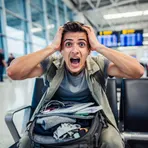
to freak out
 430
6.8
430
6.8

- phrasal verb
- /frik aʊt/
- Informal
- When she saw the spider crawling on her arm, she began to freak out and scream.
Loading YouTube…
Watch on YouTubeSo yes, they're they're very freaked out still from the alarm.
- So yes, they're they're very freaked out still from the alarm.
- Well, the banks are freaking out, and I mean the big ones.
- Maybe she got really freaked out and kind of flipped on me.
- A lot of people would freak out from all of those realities, right?
- But don't let that freak you out too much.
- And so I, I don't, I'm not freaked out personally.
- Like your team is going to freak out at that, right?
- Like would we be so freaked out we'd run for cover right?
Examples
-
But don't let that freak you out too much.
-
He started to freak out when he realized he had lost his wallet during the trip.
-
We all freak out over someone at some point.
-
So the first thing I want you to do is do not freak out, OK?
-
You know I freak out over her so hard.
-
And the problem with that is, is that people freak out, people panic.
-
People would freak out, like, literally freak out.
-
I want to know why you and Dad are so freaked out.
Fiction book (2000) -
A lot of people would freak out from all of those realities, right?
-
Lucas freaked out and decided to go ask the neighbors for help.
Synonyms
 684
7.1
684
7.1
React very strongly and lose control because of fear or shock
 289
7.5
289
7.5
Suddenly stop controlling your feelings and become very angry or upset
 272
2.3
272
2.3
To feel sudden fear and lose the ability to think or act calmly
 143
7.5
143
7.5
To suddenly become very angry, excited, or surprised
 49
7.2
49
7.2
To suddenly lose control and become very angry or upset
 14
7.3
14
7.3
To be unable to think clearly because you are very worried or upset
 11
9.2
11
9.2
React with strong fear or excitement and lose control
 5
7.7
5
7.7
To be very surprised and move suddenly because of fear
 2
8.2
2
8.2
To lose control of your feelings and act very upset
 1
9.9
1
9.9
To feel very scared and almost lose control of your body


 1
8.6
1
8.6
Become very upset or excited and act confused suddenly
 1
9.6
1
9.6
To become very worried or upset about small things

To react suddenly with fear and lose control

To panic suddenly and lose control

Get very upset and confused quickly
Antonyms


How Upset
272
2.3

- Informal
289
7.5
- Informal
430
6.8
131
3.7
362
1.0
Surface Forms
Morphology
freak + out
The noun 'freak out' (often written 'freak-out') is transparently related to the verb 'freak' (to react very strongly) plus the particle 'out', which typically intensifies or completes the action; a B1 learner who knows these constituents would likely infer an episode of an extreme reaction. However, the specific nuance of a drug-induced hallucination or delusion is a slang extension not directly predictable from the parts, so the meaning is only partially derivable without exposure.
Etymology
Freak out may come from the image of someone suddenly becoming a freak, acting out in a wild, uncontrolled way. So it now means 'to panic' or 'lose control' when frightened or shocked.