

to dip out
 1
9.1
1
9.1

- phrasal verb
- /dɪp aʊt/
- Informal
 :
escabullirse
:
escabullirse
- Feeling overwhelmed with the conversation, he made an excuse to dip out early.
And then her life gets thrown upside down and she goes for a position where she has to single handedly raise her two sons because her husband's kind of dipped out.
- And then her life gets thrown upside down and she goes for a position where she has to single handedly raise her two sons because her husband's kind of dipped out.
Examples
-
After staying for only a short time, I decided to just dip out of the party quietly.
-
So I think like while you know, you should go to happy hours or some work kind of function, you can kind of just show face and then dip out like that's kind of all you need to do.
-
Uh, guys, we might want to dip out.
-
So much you dipped out on us first chance you got.
-
I had to come see you before you dipped out of here, you know.
-
You see why I dipped out.
-
And so that's where I'll dip out the rest of the time.
-
So even though I really wanted to shout "HERPES!" in his face and dip out, I didn't.
Blog text (27) -
It wasn't really my thing, so I dipped out.
-
She didn't like the atmosphere, so she chose to dip out before it got too loud.
Synonyms
 ∞
3.0
∞
3.0
Leave a place quickly or suddenly
 632
3.5
632
3.5
Leave a person, place, or situation without taking part anymore
 234
2.3
234
2.3
Leave a room or building briefly
 206
3.4
206
3.4
To stop being involved in an activity or agreement
 175
8.4
175
8.4
To leave a place quickly or suddenly
 164
3.1
164
3.1
To leave a meeting or event suddenly to show you disagree
 156
9.9
156
9.9
To leave a place quickly, often suddenly
 147
3.7
147
3.7
To leave a place quickly and secretly to avoid trouble
 125
3.7
125
3.7
To leave a place quietly so no one notices you
 112
3.4
112
3.4
Leave a place suddenly because you are angry or protesting
 78
2.0
78
2.0
Leave a place suddenly, often to avoid someone or something
 39
3.8
39
3.8
To leave a place quietly without anyone noticing
 37
3.5
37
3.5
To leave a place suddenly to show you are angry or upset
 37
8.1
37
8.1
Tell someone to leave in a rude way
 33
4.0
33
4.0
Leave a place quietly so others do not notice
 32
3.4
32
3.4
To leave a place quietly without anyone noticing
 28
8.1
28
8.1
Leave a place suddenly and secretly to avoid trouble or debt
 22
7.2
22
7.2
To leave without telling anyone to avoid a duty or responsibility
 20
4.9
20
4.9
To stop doing a job or role politely
 17
3.6
17
3.6
To leave a place quietly without being noticed
 16
3.2
16
3.2
To leave a place for a short time to do something
 12
7.7
12
7.7
Leave a place quickly, often in a rude way
 12
7.2
12
7.2
To leave a place quickly and quietly to avoid something you should do
 11
2.8
11
2.8
To get out of a vehicle or place quickly with a small jump
 10
4.9
10
4.9
Leave a person because they are angry with you
 7
9.2
7
9.2
Leave a place quickly to avoid trouble or danger
 3
8.2
3
8.2
To leave a place quickly to escape danger
 1
9.9
1
9.9
To leave a place quickly because you do not want to be there


 1
7.9
1
7.9
Leave a place or conversation quietly to avoid attention
 1
7.9
1
7.9
To leave a place quickly, often without saying goodbye

To leave quickly to avoid trouble or attention

To leave quickly and quietly or tell someone rudely to go away

To leave a place quickly, often to avoid trouble

Leave a place quickly because you are not welcome

To leave quickly because people do not want you there

To leave a place suddenly, usually to go somewhere else
Antonyms


How Quiet

Surface Forms
Morphology
dip + out
The particle 'out' clearly signals movement away, so a learner could infer a sense of leaving; however the verb 'dip' has multiple senses (immerse, lower briefly) and its colloquial sense 'to leave quickly/quietly' is not a basic B1 meaning. The specific pragmatic flavour (leaving quietly or avoiding responsibility) is somewhat idiomatic and not fully predictable from the constituents, so it is only partially transparent.
Etymology
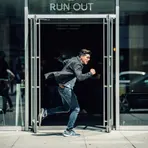
Dip out may come from the image of someone making a quick small movement, a dip, and then going out through a door or between people to slip away. So, it came to mean 'to leave quietly or suddenly without telling others'.