

to slip out
 39
3.8
39
3.8

- phrasal verb
- /slɪp aʊt/
- When the meeting got boring, he decided to slip out to grab a coffee.
- slip out the back door
- slip out of the house
Loading YouTube…
Watch on YouTubeBut I did have the tools I needed to slip out of the house once in a while on farm and prowl around Baltimore.
- But I did have the tools I needed to slip out of the house once in a while on farm and prowl around Baltimore.
- So when you slip out after giving evidence, how do you know that any of the two lads mates on the court would be cleared first?
Examples
-
Some time later, Old Mrs. Kern slipped out the door and went up the hill to her house.
Fiction book (1992) -
"See you on the throne," Wulfrith called over his shoulder as he slipped out the door.
Fiction book (1993) -
We can slip out the back, man.
-
During dinner, I slipped out and I made a call and I told her about you.
-
In the middle of the night, two boys slipped out of the house and went over to scare the girls.
Academic text (2016) -
You'd better slip out again and stay out till after daylight.
-
All we have to do is find an aristocrat and slip out while she's distracted.
-
Koop pushed open the car door, slipped out, and started down the sidewalk.
Fiction book (1994) -
No, better to creep downstairs as softly as a cat and slip out unnoticed.
Fiction book (1991) -
With the end of the Lopez Portillo government, Durazo quietly slipped out of the country.
Academic text (1990)
Synonyms
 699
2.8
699
2.8
To move or take something quietly so others do not notice
 632
3.5
632
3.5
Leave a person, place, or situation without taking part anymore
 234
2.3
234
2.3
Leave a room or building briefly
 147
3.7
147
3.7
To leave a place quickly and secretly to avoid trouble
 125
3.7
125
3.7
To leave a place quietly so no one notices you
 33
4.0
33
4.0
Leave a place quietly so others do not notice
 32
3.4
32
3.4
To leave a place quietly without anyone noticing
 28
8.1
28
8.1
Leave a place suddenly and secretly to avoid trouble or debt
 17
3.6
17
3.6
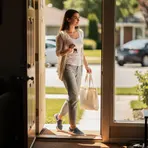
To leave a place quietly without being noticed
 16
3.2
16
3.2
To leave a place for a short time to do something
 16
6.7
16
6.7
To move quietly and carefully to avoid being seen
 12
7.2
12
7.2
To leave a place quickly and quietly to avoid something you should do
 4
6.3
4
6.3
To leave a meeting or party quietly so no one notices
 4
8.5
4
8.5
To leave a place quickly and secretly to avoid being caught
 4
9.9
4
9.9
To leave a place suddenly without telling anyone to avoid trouble
 1
9.1
1
9.1
To leave a place quietly or suddenly without telling others


 1
7.7
1
7.7
To move quietly to the side and away so people do not notice you
 1
7.9
1
7.9
Leave a place or conversation quietly to avoid attention
 1
7.9
1
7.9
To leave a place quickly, often without saying goodbye

To leave a place quickly and secretly, often taking things or someone
Antonyms


How Quiet
- Formal
11
8.5

- Informal
125
3.7
39
3.8
∞
1.0
234
2.3
Surface Forms
Morphology
The meaning 'to leave a place quietly or secretly' is directly compositional from 'slip' (to move smoothly/quietly) + 'out' (away from the interior), so a B1 learner who knows both words can readily infer the sense. This verb+particle motion pattern is common cross-linguistically and follows standard English phrasal-verb composition, making the expression predictable and transparent.
Etymology
The phrasal verb slip out comes from the image of someone quietly sliding away from a room: to slip is to move smoothly and quietly and out shows they leave. So it means 'to leave a place quietly or secretly, without being noticed'.