
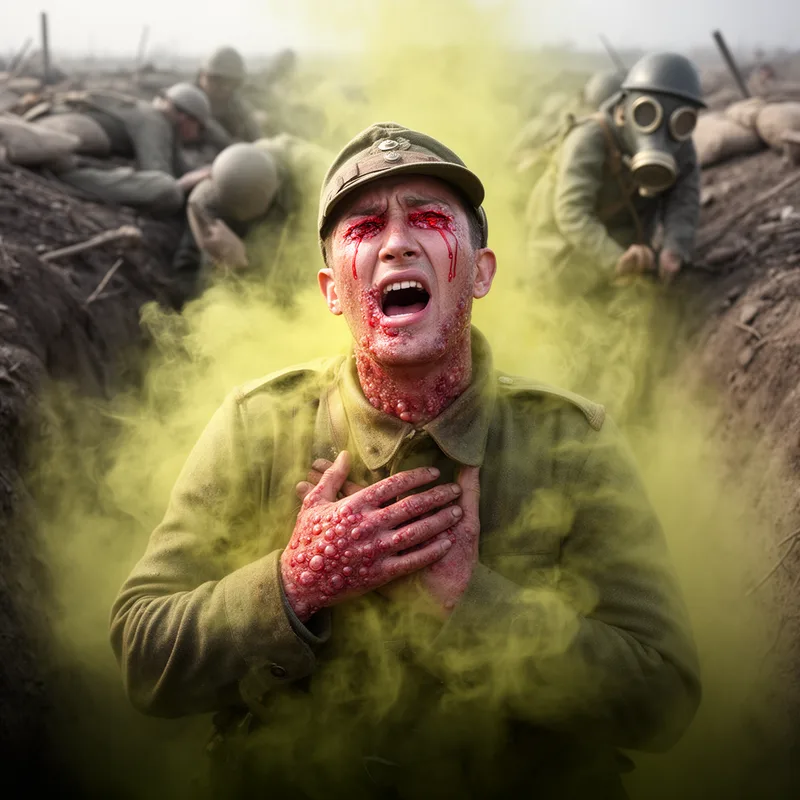
dichloroethyl sulfide
- noun
- /daɪˈklɔːroʊˌɛθəl ˈsʌlfaɪd/
- NSFW
- Exposure to dichloroethyl sulfide can lead to severe health issues.
Examples
-
Researchers are developing better protective clothing to shield against dichloroethyl sulfide exposure.
-
The use of dichloroethyl sulfide during World War I led to countless injuries among soldiers.
-
Even a small release of dichloroethyl sulfide can have devastating effects on people and the environment.
-
The military banned the use of dichloroethyl sulfide after World War I.
-
Even a small release of dichloroethyl sulfide can have devastating effects on people and the environment.
-
Researchers are developing better protective clothing to shield against dichloroethyl sulfide exposure.
-
The use of dichloroethyl sulfide during World War I led to countless injuries among soldiers.
Synonyms
 12
5.7
12
5.7

A harmful gas used as a weapon that can kill or make people very sick if they breathe it
 6
7.7
6
7.7
A poison gas used in war that causes painful blisters and damages the lungs

 1
9.9
1
9.9
A very strong chemical weapon that causes severe blisters and harms the lungs and eyes

A poisonous chemical used in war that causes severe blisters and eye and lung damage

A poisonous gas, also called mustard gas, that causes severe skin blisters and lung damage

A harmful chemical that causes severe blisters on skin and damages eyes and lungs, often used as a weapon
Surface Forms
Morphology
dichloroethyl + sulfide
The name is morphologically compositional: 'sulfide' clearly signals a sulfur-containing chemical and 'dichloroethyl' (di- + chloro- + ethyl) indicates a chlorine-substituted ethyl group, so a learner could infer it is a chemical compound. However, the specific identity as mustard gas and its toxic/weaponized properties are specialized, not predictable from the parts (and 'dichloroethyl' is unlikely to be known at B1), so full meaning is not directly derivable.
Etymology
Dichloroethyl sulfide is named from its parts: di- means 'two', chloro- means 'chlorine', ethyl is 'a small carbon part', and sulfide means 'sulfur'. This chemical is better known as 'mustard gas' and was used in war because it causes severe blisters and breathing damage, so the name points to a dangerous substance.