

cyanobacteria
 3
7.5
3
7.5

- noun
- /ˌsaɪənəʊˈbækˌtɪəriə/
- Specialized
- In anybody of water that receives sufficient sunlight, plant like organisms such as algae and cyanobacteria thrive.
- filamentous cyanobacteria
- cyanobacteria and algae
- mats of cyanobacteria
Loading YouTube…
Watch on YouTubeSo we we use cyanobacteria very frequently in the lab.
- So we we use cyanobacteria very frequently in the lab.
Examples
-
Almost every organism on the planet has an internal clock: animals, plants, fungi, and cyanobacteria all have daily rhythms.
Academic text (2005) -
From this experiment, "it's clear that you don't need these loops for a circadian rhythm in cyanobacteria," says McClung.
Academic text (2005) -
So we we use cyanobacteria very frequently in the lab.
-
These are the cyanobacteria that can harvest sunlight.
-
Furthermore, the J. Craig Venter Institute is also working with cyanobacteria to produce hydrogen from water.
Blog text (33) -
The microbial communities present in the dry valley streams consist primarily of cyanobacteria, although chlorophytes and diatoms are also common.
Academic text (1999) -
We put a fertile nutrient culture of cyanobacteria in a liter of sterile Navetta seawater.
Fiction book (1999) -
For example, increasing temperatures may enhance conditions for the proliferation of cyanobacteria and algae (Joehnk et al. 2008; Newcombe et al. 2012; Paerl and Huisman 2008).
Academic text (2014) -
In many ecosystems, cyanobacteria play a crucial role by converting sunlight into energy and producing oxygen.
-
Scientists study cyanobacteria to understand their significant contribution to the Earth's early atmosphere.
Synonyms


 1
4.1
1
4.1
Tiny living things in water that make food from light and often look blue-green

A group of simple water organisms like blue-green algae that make food from sunlight and produce oxygen

Microscopic blue-green bacteria that live in water and make food using sunlight

A group of bacteria like blue-green algae that make food from sunlight and live in water and soil

An old name for blue-green algae now called cyanobacteria
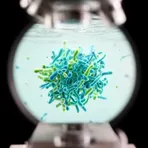
A group of simple living things now called blue-green algae

An old name for blue-green bacteria also called cyanobacteria
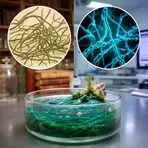
An old scientific name for blue-green algae now called cyanobacteria
Surface Forms
Morphology
Etymology
Cyanobacteria comes from the Greek part cyan- meaning 'blue' and the word bacteria meaning 'tiny living things'. So it literally means 'blue bacteria', which helps you remember that these water bacteria are blue-green and use sunlight to make food and oxygen.