

Cyanophyta
- noun
- /ˌsaɪəˈnɒfɪtə/
- Archaic
- Modern taxonomy often refers to Cyanophyta as cyanobacteria rather than as a type of algae.
Examples
-
Cyanophyta are fascinating organisms.
-
The Cyanophyta are essential to early earth ecosystems because of their ability to produce oxygen through photosynthesis.
-
Some scientists classify Cyanophyta as the earliest known organisms capable of oxygenic photosynthesis.
-
The Cyanophyta group includes organisms that can photosynthesize.
-
Cyanophyta, commonly known as cyanophyta, are important for oxygen production in aquatic environments.
-
Many researchers study cyanophyta to understand their role in the ecosystem as primary producers.
-
The cyanophyta thrive in various environments including freshwater, marine, and even extreme settings like hot springs.
Synonyms

 3
7.5
3
7.5

Bacteria that make food from sunlight and give oxygen, often blue-green and found in water


 1
4.1
1
4.1
Tiny living things in water that make food from light and often look blue-green

A group of bacteria like blue-green algae that make food from sunlight and live in water and soil

Microscopic blue-green bacteria that live in water and make food using sunlight

An old name for blue-green bacteria also called cyanobacteria

An old name for blue-green algae now called cyanobacteria
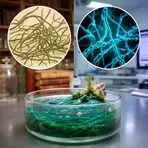
An old scientific name for blue-green algae now called cyanobacteria

An old scientific name for blue-green algae now called cyanobacteria

A group of simple living things now called blue-green algae
Compounds
- Archaic
A group of bacteria like blue-green algae that make food from sunlight and live in water and soil
Surface Forms
Morphology
Etymology
Cyanophyta comes from cyan ('blue') and phyta ('plants'), so it literally means 'blue plants'. That's a helpful memory: these are the blue-green organisms that make food from sunlight and produce oxygen, though scientists now usually call them cyanobacteria because they are bacteria, not true plants.