
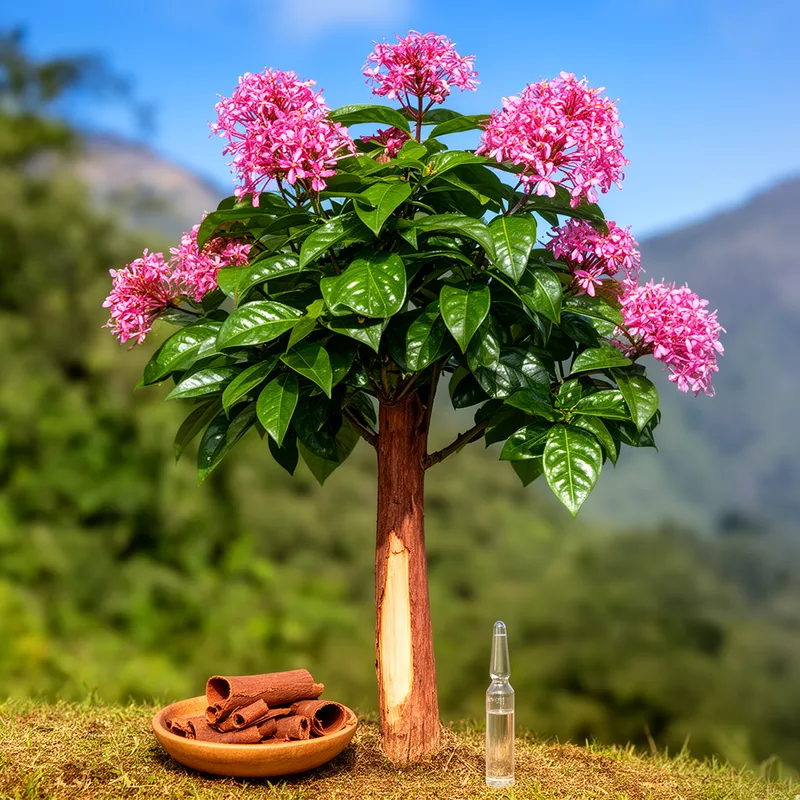
cinchona tree
- noun
- /sɪnˈkoʊnə tri/
- Powdered bark from the cinchona tree, found only on the eastern slopes of the Peruvian Andes, contained alkaloids that checked malaria.
- bark of the cinchona tree
Examples
-
Botanists are working to conserve endangered cinchona trees in South America.
-
The cinchona tree produces fragrant pink flowers and striking glossy leaves.
-
The bark of the cinchona tree is famous as a natural source of quinine.
-
The cinchona tree is essential for producing quinine.
-
Many cinchona trees grow in the Amazon rainforest.
-
The bark of the cinchona tree was used 400 years ago to reduce fever.
-
Quinine, extracted from the bark of the cinchona tree, was used as an antimalarial agent as early as 1632.
Synonyms

A small tree that has shiny leaves, pink flowers, and bark people use to treat malaria

A South American tree whose bark contains quinine that treats malaria

A shrub or small tree from Peru with shiny leaves and scented flowers, grown for its bark used in medicine
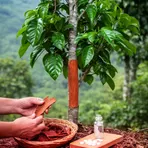
A South American bush or small tree with shiny leaves, grown for bark used to make the medicine quinine

A tree from Colombia whose bark is used for medicine

A Colombian tree with bark used to make medicine for malaria
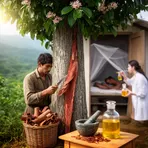
A South American tree whose bark gives a medicine for malaria

A group of South American trees whose bark gives quinine, a medicine for malaria
Surface Forms
Morphology
The phrase is a straightforward noun-noun combination of a species name plus the general noun 'tree' so its meaning ('a tree of the cinchona genus') is directly derivable from knowing 'cinchona' and 'tree'. This compositional botanical naming pattern is cross-linguistically common and contains no idiomatic or metaphorical sense, so a learner who knows both constituents will understand it.
Etymology
Cinchona tree may come from a story about a Spanish countess from Chinchón who, long ago, was healed by the tree's bark. Because that bark makes a strong medicine called quinine that fights 'fever' and 'malaria', people remembered the tree by that name.

