

Cinchona officinalis
- noun
- Specialized
- The bark of Cinchona officinalis is famous for containing quinine, an early treatment for malaria.
Examples
-
The bark of the Cinchona officinalis tree is used to produce quinine.
-
Did you know that Cinchona officinalis is native to South America?
-
Many botanical gardens cultivate Cinchona officinalis due to its historical medicinal use.
-
The extraction of quinine from Cinchona officinalis was a crucial breakthrough in medicine.
-
The bark of Cinchona officinalis is harvested for its medicinal properties, particularly in the production of quinine.
-
Researchers study Cinchona officinalis to better understand its effects in treating fevers and malaria.
-
Historically, Cinchona officinalis was referred to as the 'fever tree' because of its role in medicine.
Synonyms

A small South American tree with shiny leaves and pink flowers whose bark gives quinine
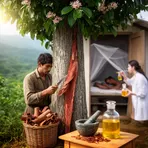
A South American tree whose bark gives a medicine for malaria
Surface Forms
Morphology
The meaning is directly derivable from the constituents: 'Cinchona' names the South American tree and 'officinalis' signals a plant with acknowledged medicinal use, so together they indicate a medicinal Cinchona species (the tree whose bark yields quinine). Botanical Latin routinely uses 'officinalis' to mark medicinal species, making the compound predictable for learners who know both words.
Etymology
Cinchona officinalis may come from the 17th-century Countess of Chinchón, who, one popular story says, was cured of 'fever' after local people gave her the tree's bark. That's why the name and the word officinalis remind us that this tree was used as a medicine and is the source of quinine.

