

chinaberry tree
- noun
- /ˈtʃaɪnəˌbɛri tri/
- The children played under the cool shade of the chinaberry tree in the backyard.
Examples
-
On hot summer days, the chinaberry tree provides a welcome escape from the sun.
-
So I walked out and I got under the Chinaberry tree.
-
The morning shade under the chinaberry tree held the same quality as the light: brittle and arrogant.
Fiction book (1997) -
José: Across from her house there were some chinaberry trees, you see.
Fiction book (1992) -
The oily glass of water, tossed at the heat-drunk dog beneath the chinaberry tree, is no substitute for tears.
Fiction book (1992) -
And the dog, who smolders beneath the chinaberry tree, and then flames briefly and gloriously into the night, is no more and no less bright than the sun, the moon, and the woman waiting alone through the shabby night.
Fiction book (1992) -
We enjoyed our picnic beneath a large chinaberry tree that bloomed with purple flowers.
Synonyms


 1
9.6
1
9.6
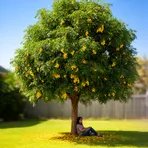
A tree with small yellow berries and broad leaves that gives shade
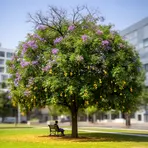
A tree that loses its leaves with purple flowers and small yellow fruits often grown for shade

A tree that loses its leaves and has purple flowers and small yellow fruit grown for shade

A tree with purple flowers and small yellow fruits that are not edible, grown for shade in warm places

A tree with purple flowers and yellow inedible fruit used for shade
Surface Forms
Morphology
The phrase is fully compositional: 'chinaberry' names a specific plant and adding 'tree' simply indicates that it is that plant in arboreal form. A B1 learner who knows the constituents ('chinaberry' = a particular plant; 'tree' = tall perennial plant) can derive the meaning without prior exposure, and noun + tree naming is cross-linguistically common.
Etymology
The noun chinaberry tree gets its name from two simple facts: the tree came from China and it makes many small yellow berries. That's why the name means a tree from Asia with round fruits that look like berries and that people often plant for shade.