
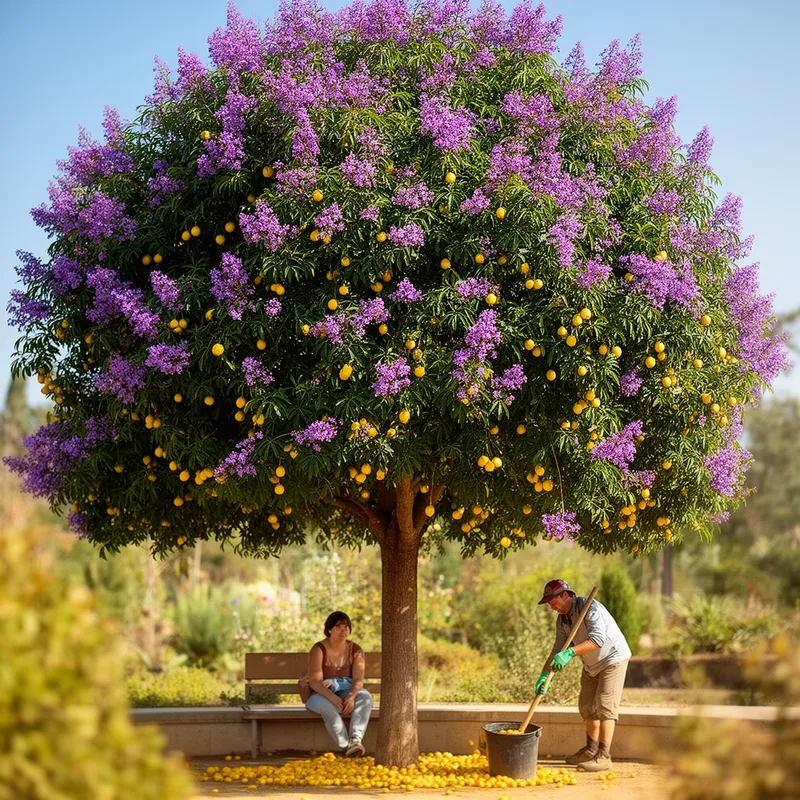
Melia azedarach
- noun
- /ˈmiliə ˌæzəˈdɛræk/
- Specialized
- The Melia azedarach is prized for its ornamental flowers in many gardens across the southern United States.
Examples
-
Despite its beauty, the fruit of Melia azedarach is not edible for humans.
-
The Melia azedarach tree provides excellent shade in summer.
-
Botanists studied the spread of Melia azedarach after it was introduced from Asia.
-
In India, the Melia azedarach is commonly planted along roads.
-
The Melia azedarach tree provides excellent shade in summer.
-
Despite its beauty, the fruit of Melia azedarach is not edible for humans.
-
In India, the Melia azedarach is commonly planted along roads.
Synonyms


 1
9.6
1
9.6
A tree with small yellow berries and broad leaves that gives shade

A tree with purple flowers and yellow inedible fruit used for shade
A tree with purple flowers and small yellow fruit you cannot eat, often used for shade
A tree that loses its leaves with purple flowers and small yellow fruits often grown for shade

A tree that loses its leaves and has purple flowers and small yellow fruit grown for shade

A tree with clusters of purple flowers and small yellow fruits you cannot eat
Surface Forms
Morphology
Both constituents are literal botanical terms referring to trees and their features, so a learner who knows 'Melia' as a type of deciduous tree and 'azedarach' as a tree with purple flowers/inedible fruit can infer this denotes that specific tree. This is a straightforward taxonomic label (not idiomatic or metaphorical) and thus compositional and predictable from the parts.
Etymology
Melia azedarach may come from old Greek and Persian words. Greek Melia was a word for a tree like the ash, and Persian azedarach meant 'free tree', so the name gives the image of an ash-like tree that grows freely, which fits the plant today.