
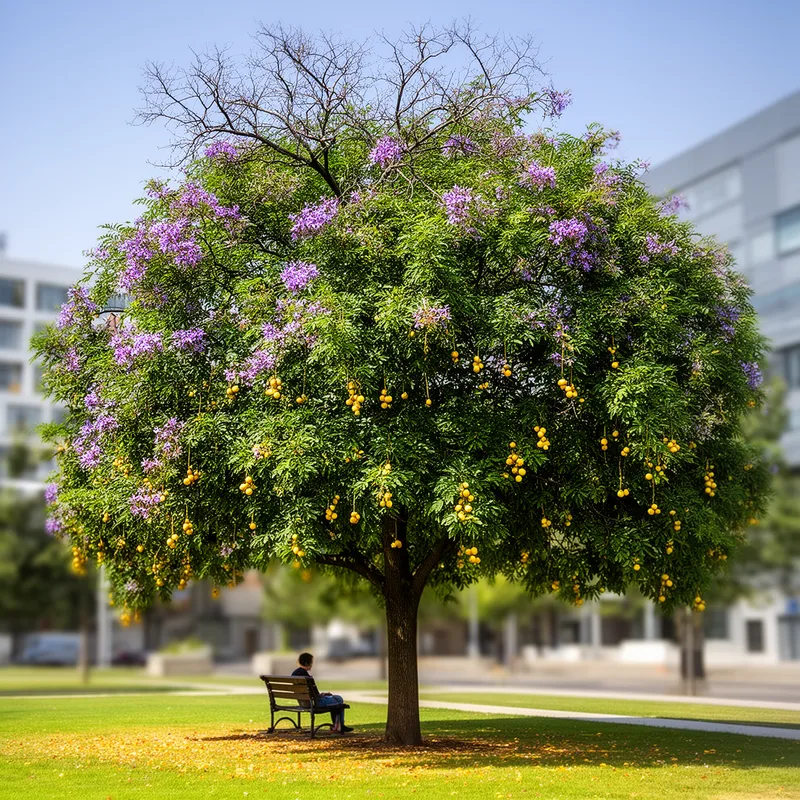
Melia azederach
- noun
- Specialized
- The Melia azederach is often planted as an ornamental tree in gardens across the southern United States.
Examples
-
In our garden, we planted a Melia azederach for its beautiful purple blossoms.
-
The shade provided by the Melia azederach makes it a popular choice for urban landscapes.
-
Researchers studied the medicinal uses of Melia azederach in traditional Chinese remedies.
-
The Melia azederach tree provides excellent shade during the summer.
-
The Melia azederach tree is known for its stunning purple blossoms, making it a favorite in southern gardens.
-
Many homeowners choose to plant a Melia azederach in their yards because it provides a large amount of shade.
-
The Melia azederach thrives in warm climates, and its small yellow fruits are a distinctive feature.
Synonyms


 1
9.6
1
9.6
A tree with small yellow berries and broad leaves that gives shade
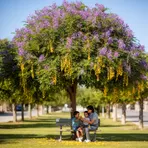
A tree with purple flowers and small yellow fruit you cannot eat, often used for shade

A tree with clusters of purple flowers and small yellow fruits you cannot eat

A tree that loses its leaves and has purple flowers and small yellow fruit grown for shade
Surface Forms
Morphology
Both constituents are clearly tree-related (Melia: deciduous trees; azedarach: a tree with purple flowers and inedible fruit), so their combination transparently denotes a particular kind of tree with those features. Although it is a Latin binomial and may be unfamiliar as a name, the overall meaning is directly derivable from the parts and thus predictable to a learner who knows both words.
Etymology
Melia azederach is the scientific Latin name for the 'chinaberry' tree, a small tree with purple flowers and shiny yellow, bead-like fruits. Because people in India and China planted it in gardens for shade and used parts of it in simple medicines, the name now refers to this ornamental shade tree and its traditional uses.