

blue false indigo
- noun
- /blu fɔls ˈɪndɪgoʊ/
- US
- She planted blue false indigo along the fence for its striking color and resilience.
Examples
-
Native pollinators are attracted to the vibrant flowers of blue false indigo.
-
The garden was filled with blooming blue false indigo in early summer.
-
The garden features beautiful blue false indigo plants.
-
I saw a blue false indigo blooming in the park.
-
Native pollinators are attracted to the vibrant flowers of blue false indigo.
-
She planted blue false indigo along the fence for its striking color and resilience.
-
The garden was filled with blooming blue false indigo in early summer.
Synonyms

A plant that lives many years with blue, pea-like flowers often grown in gardens

A North American plant with blue, white, or yellow flowers that grows in prairies and open woods
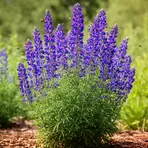
A North American shrub with blue or purple flowers often grown in gardens
Surface Forms
Morphology
The phrase is compositionally built: 'blue' describes the color, and 'false indigo' is interpretable as a plant resembling true indigo but not the actual dye-producing indigo. A B1 learner who knows the constituent words can therefore infer this refers to a (blue-flowering) plant similar to indigo, even if they don't know the exact species name.
Etymology
Blue false indigo gets its name because it has spikes of blue flowers that look like the dye plant indigo. The word false was added to show it is not the 'true' indigo, so the name tells us it looks like indigo but is a different plant.

