

Baptisia australis
- noun
- /bæpˈtɪziə ˌɔːˈstrælɪs/
- Specialized
- The brilliant blue flowers of Baptisia australis make it a favorite in ornamental gardens.
Examples
-
Many pollinators, including bees, are attracted to Baptisia australis during its blooming season.
-
Gardeners appreciate how hardy Baptisia australis is, even in poor soil conditions.
-
I planted Baptisia australis in my garden last spring.
-
Did you see the Baptisia australis blooming this year?
-
Many pollinators, including bees, are attracted to Baptisia australis during its blooming season.
-
The brilliant blue flowers of Baptisia australis make it a favorite in ornamental gardens.
-
Gardeners appreciate how hardy Baptisia australis is, even in poor soil conditions.
Synonyms
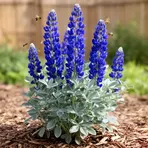
A North American plant that lives for many years with spikes of blue flowers and gray-green leaves

A North American plant with blue, white, or yellow flowers that grows in prairies and open woods
Surface Forms
Morphology
Baptisia + australis
This is a Latin binomial (genus + species) so a learner who knows 'Baptisia' would recognize it as a plant name, making the fact that it denotes a particular species somewhat transparent. However, the species epithet 'australis' is a Latin element (no dictionary gloss provided here) and does not convey the specific attributes (wild indigo, blue pea-like flowers, native range) to a B1 learner, so the full meaning is not derivable from the parts.
Etymology
Baptisia australis comes from Greek and Latin words: Baptisia from a word meaning 'to dip' because people used the plant like wild indigo to make blue dye, and australis meaning 'southern'. So the name points to its deep blue, indigo-like flowers and the plant's old use as a dye.

