
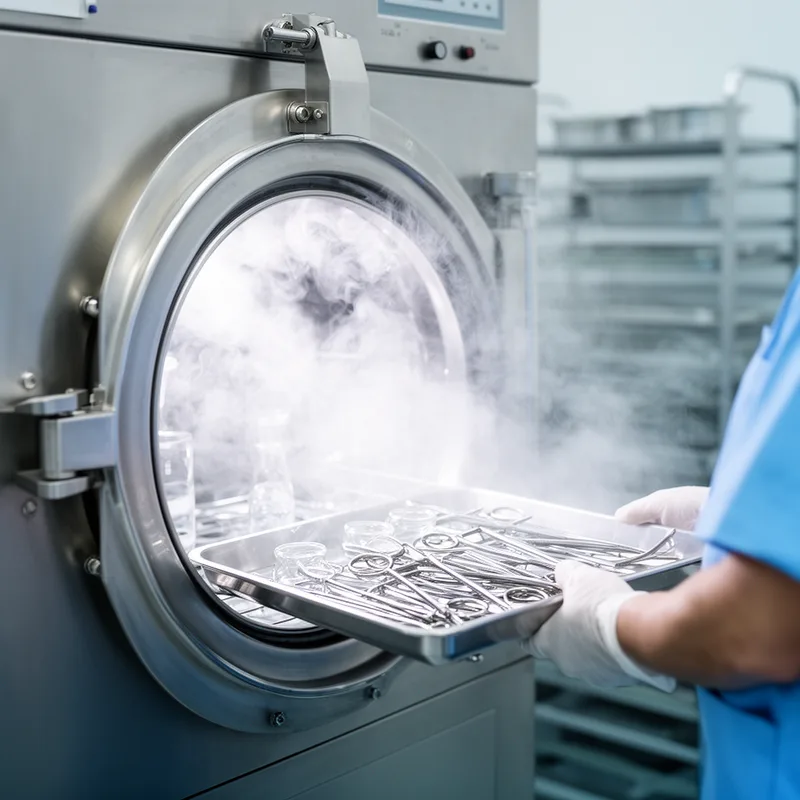
to autoclave


 1
8.8
1
8.8
- verb
- /ˈɔːtəˌkleɪv/
- Specialized
- Before the procedure, we need to autoclave the tools to make sure they are sterilized.
- autoclaved for 30 minutes
Examples
-
The swabs were tied with twine, wrapped in aluminum foil, and autoclaved.
Academic text (2002) -
- The instruments are autoclaved.
-
SAM should be handled with powderless gloves and can be autoclaved up to three times using gas or steam techniques without compromising its quality.
Academic text (1995) -
The needles can be reused after being cleaned with soapy water and autoclaved.
Blog text (1) -
Vial storage boxes can be autoclaved and are made from either polycarbonate or economical chipboard.
Academic text (1998) -
The four surface materials were autoclaved for 30 minutes at 121°C before inoculation (no damage to the paper surface was visible after the autoclave).
Academic text (2003) -
All cloths were divided into 310-cm² portions and autoclaved for 20 minutes at 200 kPa.
Academic text (2005) -
All fecal specimens are stored for 1 year at -20°C and discarded by autoclaving.
Academic text (2012) -
The surgical instruments must be autoclaved to ensure they are free of any bacteria.
-
After cleaning, the lab equipment was autoclaved to eliminate any remaining pathogens.
Synonyms
 29
4.1
29
4.1
To make something like medical tools free of bacteria using heat or chemicals
How Sterile
- Specialized
1
8.8

- Specialized
29
4.1
18
3.7
- US
11
3.7
∞
1.0
Surface Forms
Etymology
Autoclave as a verb comes from the same parts auto- 'self' and clave 'key' or 'lock', meaning 'self-locking', so to autoclave something is to put it in that sealed, high-pressure device to make it sterile.