
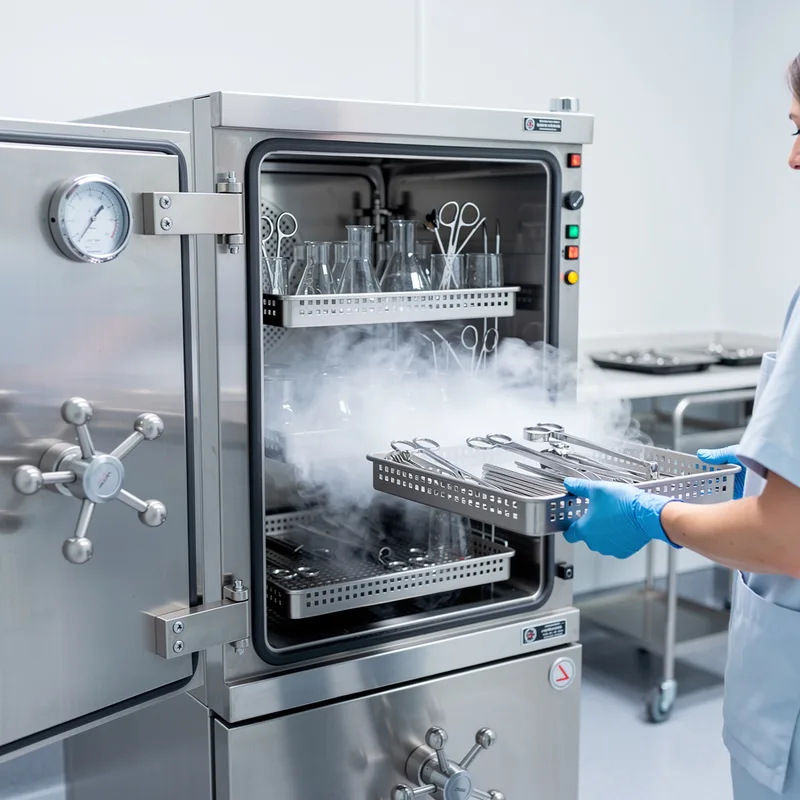
autoclave
 2
8.3
2
8.3

- noun
- /ˈɔːtəˌkleɪv/
- Specialized
- The surgical instruments were placed in the autoclave to ensure they were properly sterilized before the operation.
- use of autoclaves
Examples
-
The facilities include the American Ref-Fuel trash-to-steam incinerator, the Delcora sewage-treatment plant, and the Thermal Pure Systems medical-waste autoclave.
Academic text (2000) -
Constituents of both fiber and matrix are assembled together in a large chamber (an autoclave), which is then heated and internally pressurized with an inert gas.
Academic text (1999) -
How high can this autoclave run without ruining my product?
-
The material was manufactured in an autoclave called the Bakelizer.
Academic text (2007) -
Ninety percent of the respondents indicated that autoclaves were used for biohazardous waste treatment at their institutions.
Academic text (2003) -
With respect to on-site waste treatment methods, 90 percent of respondents indicated that they were using autoclaves for the treatment of biohazardous waste.
Academic text (2003) -
Media were sterilized using an autoclave for 20 minutes at 121 °C and 15 psi.
Academic text (2015) -
Researchers used the autoclave to create a new material under high pressure and temperature conditions.
-
To eliminate any contaminants, the lab technician placed all glassware in the autoclave for sterilization.
Synonyms
 2
3.9
2
3.9
A machine that uses heat or chemicals to kill germs on tools
How Pressurized

Surface Forms
Morphology
autoclave = clave (opaque) = auto + clave
The word is historically built from auto- plus a form meaning 'key' or 'lock', but the second element is not a productive English word for most learners.
Etymology
Autoclave comes from the parts auto- 'self' and clave 'key' or 'lock', so it originally meant a 'self-locking' container. That's why an autoclave is a strong, sealed machine that holds steam under pressure to sterilize instruments.